Showing posts with label Chongwe. Show all posts

Thursday, 16 October 2014

Potentially Tomopterna cryptotis (Boulenger, 1907)

This little chule troubles me.

Photographed 04/01/2014 using Olympus E-420 DSLR with 40-150mm Zuiko lens and 1 KOOD magnifier. Chongwe, Lusaka, Zambia.

I had originally filed it as Leptopelis bocagii; a mistake made much easier by the here almost perfectly round pupil; unlike Leptopelis, however, I'm fairly sure that in daylight, this little frog has a horizontal pupil.

It does, at a glance, resemble Leptopelis as found on the farm - it is a chubby, pale frog, active at night and not overly active, with a faint, symmetrical dorsal pattern. It is blunt-faced, rough-skinned, and - unlike our other locally common chubby, burrowing frog, Breviceps powerii - it can, at least in theory, jump.

But then there came doubt. Leptopelis bocagii, and our other Arthroleptid (Arthroleptis stenodactylus) both show rough skin on their bellies; this one, although it's not at its most visible here, has a clean, bright white belly all the way back.

Unlike L. bocagii , it also has a little, almost glandular ridge running around the corner of its mouth, giving it a decidedly disapproving expression that seems to be most commonly associated with Ranidae, and certainly seems to be absent from the Arthroleptidae. In fact, ignoring the colouring - which is in the first place very variable, and in the second place is often paler at night, especially when a frog's been taking a swim in a chlorinated pool - and noting that the pupil is, in this instance, uninformative, it's actually got very little to relate him to Leptopelis; the snout is too bulbous, the legs are too short, and the tympanum (ear) is very nearly invisible.

And finally, there was a little white protuberance on the heel of the back foot:


 Which all seems to point, at least in theory, to the sand frogs (Tomopterna). The nearly invisible Tympanum - which is somewhat more visible in the first picture, where the animal's overall colour is paler - would suggest Tomopterna cryptotis, but at least two other species - T. krugerensis and T. tandyi; if this is, actually, Tomopterna at all, the call is listed as the only reliable way to separate these three; T. cryptotis is our tentative identification only because the other two have not, to my knowledge, been recorded from Zambia.


It's worth noting that they are not usually found in swimming pools; they are typically associated with rivers and temporary pools, where they bury themselves in the sand when the water retreats - the little flange on the foot is an aid to rapid burrowing. There are, however, several small streams and rivers in the wider area, some of them barely an hours walk away, which quite likely went from dry to flooded in the weeks before this little one was found.


As far as frogs are concerned, I have bypassed my commitment to freely available literature, and instead use Alan Channing's Amphibians of Central and Southern Africa; it's awesome and I really feel that more people should own it.


Friday, 25 July 2014

Trigonidium cicindeloides (possibly), Rambur 1838

Cricket!

It's summer. It's very hot. There are lots of insects around and about in the UK right now, and I've been tormenting them with the camera while completely failing to maintain this blog.

This is not one of them:

Male? Chongwe, Lusaka, Zambia, March 2013. Olympus E-420 DSLR with Zuiko 40-150mm lens and 3 KOOD magnifiers.

This little chukululu is, as you may guess from the Chewa introduction, a Zambian. In other languages, this widespread subfamily of crickets are known as Sword-tail crickets  in English, and Käfergrille (~black cricket) in German. To, as we've been attempting without much success, give it a more specific label in Chewa, we could translate the English directly to Lupanga-Khombo Chukululu, or perhaps, with an attempt at grammatical correctness, Chukululu ndi Khombo yonga Lupanga.

A more specific identity is a little iffy; it does belong to the genus Trigonidium, and bears a very strong resemblance to members of its putative species,

Trigonidium (Trigonidium) cicindeloides
Rambur, 1838.

There are, however, a fair number of Trigonidium species native to sub-Saharan Africa. None of them, interestingly, are noted by the - brilliant -  Orthoptera Species File as recorded from Zambia, but at least two very distinct forms are present in Chongwe district, which correspond in form closely to two widely distributed species recorded from neighbouring countries or - in the case of T. cicindeloides - recorded from an interrupted range of countries that suggest its presence in Zambia. While there are other species described from neighbouring countries, these are of such limited known range and recent distribution that it would be incautious to predict their presence in Zambia.

The location itself is further suggestive of the species the two so closely resemble - both were in an agricultural, regularly disturbed area not far from Lusaka city; notably widespread species, recorded - as both this and the (unshown) T. erythrocephala are - primarily from the most developed corners of the continent - are more likely to have the adaptability to survive, and even thrive, in such a human-dominated environment.

So, waffle over, and another angle of our little lupanga-khombo chukululu


Eukaryota; Animalia; Eumetazoa; Bilateralia; Nephrozoa; Protostomia; Ecdysozoa; Arthropoda; Hexapoda; Insecta; Dicondylia; Pterygota; Metapterygota; Neoptera; Polyneoptera; Anartioptera; Polyorthoptera; Orthopterida; Panorthoptera; Orthoptera; Ensifera; Grylloidea; Gryllidae; Trigonidiinae; Trigonidiini.

Thursday, 26 June 2014

Catopsilia florella (Fabricius 1775)

Four days into national insect week, it seems as though it would be atrocious if I allowed the long-standing funk I seem to be in to stop me from posting something appropriate.

I had planned a lengthy discourse with tons of pictures of invertebrates, but focusing on anything lately has not been very doable (you may have noticed, in the unlikely event that you read through it, that the lengthy taxonomic notes have disappeared from recent posts. Which makes navigation harder, but saves about half an hour of distractedly re-doing the same thing.

Anyway, whining over, meet today's guest:

Lusaka City, Lusaka Province, Zambia, in October 2011. Photographed with Olympus E-420 DSLR, Zuiko 40-150mm lens and 3 KOOD magnifiers.
This soft-touch of an entry to a blog supposedly focusing on under-loved groups (in my defence, it was suggested by a random number generator) is one of Zambia's many Agulugufe (Chewa - plural of gulugufe), but is far from endemic; it extends through most of Africa, including island nations such as Madagascar and the Canary islands - which, having remained a territory (=colony) of Spain, is often used by entomologists to say that the butterfly is found in Europe. A little bit like saying that penguins breed on British shores when they're actually in the Falklands, but I digress.

This gulugufe is also found as far east as India and Sri Lanka (பட்டாம், ~Pattaam in Tamil; तितली, ~Dtidt(a)li in Hindi), and just in case you hadn't worked it out from the picture, the English term is Butterfly. 


As an etymological aside, one Chewa term for these distinctly user-friendly insects is Peperu, which is, to my ears at least, surprisingly close to the French Papillon.

As with a lot of insects which are not particularly edible, a common name specific to the species is difficult to find in Chewa; the most direct translation from the English '[African] Migrant' I can find is Matchona, which means migrant workers, and, by its structure and the persistent use of Zimbabwe in the example usages, would seem to refer even more specifically to members of the Shona people of Zimbabwe, who make up a considerable proportion of migrant workers in Zambia and Malawi.

So I am forced to think more broadly for a Chewa name to reflect the nature of these insects; Mlendo, which translates most directly to Guest, but can also mean Stranger, Tourist, Foreigner or Traveller, seems the most appropriate.

Our Mlendo Gulugufe can be referred to, internationally, as

Catopsilia florella
(Fabricius, 1775)

Within the butterflies, it is in a generally not white subfamily (Coliadinae) of the 'White' Butterflies (gugulufe loyera), the Pieridae, of which only one other butterfly has thus far been featured, the also not-white (but in the largely white-ish subfamily, Pierinae) Eurasian Orange-Tip, Anthocharis cardamines


Same as opening image, but only 1 KOOD magnifier.
As with most butterflies, there is sexual dimorphism (males and females look different), but with the Mlendo Gugulufe it is imperfect; while the individual to the right(the same one pictured at the top of the post) shows a colour form found in both males and females, the more cryptic colouring  of the specimen below is only known from females. 

Photographed in Chongwe, Lusaka, Zambia, in February 2013, using Olympus E-420 DSLR and 40-150mm Zuiko lens with 1 KOOD magnifier.


And that, folks, is all.


For the identification of large and distinctive African butterflies, the most comprehensive guide I've found affordable is Steve Woodhall's Field Guide to Butterflies of South Africa, published through Struik and available through Amazon (here). As I remain the world's biggest fan of free information, I can't go without mentioning the late R. C. Dening's collection, which, although not as user friendly, is more appropriate to Zambia and, key point, freely accessible online (click here to visit it).

Friday, 9 May 2014

Chamaeleo dilepis, Leach, 1819

Welcome to a bit of a picture heavy post.

This lovely lizard is the subject of a bit of a family obsession:

Photographed in Chongwe, Lusaka, Zambia in December 2013, using Olympus E-420 DSLR
and Zuiko 70-300 telephoto lens.

As far as current knowledge goes, this is the only member of its family native to the Lusaka area. A significant chunk of my school time was spent retrieving these lizards from the centre of a panicked crowd and removing them to a safe distance.

There is a widespread distrust of chameleons in Sub-Saharan Africa - in Lusaka, the traditional myth seems to be that if you are bitten, you are cursed and one of your family is going to die. In the city, this is generally transmuted to their being highly venomous, or harbouring deadly bacteria on their teeth - All of which is patently not true. An angry specimen, with sharply defined markings and throat inflated to show brightly coloured skin usually hidden in folds, can look quite imposing, but having handled countless terrified individuals through my life, and been bitten well over twenty times (my father, notably, once demonstrated their harmlessness by allowing one to bite him on the tongue), I can confirm that it's bite is less painful and no more dangerous than being pinched by someone with medium-length fingernails. 

Have a look at another individual pretending to be twig while I babble about language:


Chongwe, Lusaka, Zambia in October 2011, using
Olympus E-420 with 40-150mm Zuiko lens


I'm not familiar with any Afrikaans names for this creature - a Chewa term is Birimankhwe, considering the more-or-less interchangeable nature of  'L' and 'R' in many Zambian dialects, its Soli name of Bilimankhwe is essentially identical. Kalilombe and Likakatuwe (both Chewa) are usually for larger specimens; Nanzikambe and Tonkhwetonkhwe are also listed by my Chewa dictionary, although I don't recall hearing either of these, or Likakatuwe, in use.


A closely related species is present in southern parts of Europe; in Spanish, Camaleón, which is more-or-less representative of most European names for this lizard (including the English Chameleon).

Further east, a number of species are found on the Indian subcontinent, and the Tamil  பச்சோந்தி

(~Pachonti) is possibly my favourite non-Zambian name.

The only species known to be present over much of Zambia, and extending across most of Sub-Saharan Africa, in English this is known as the Flap Necked Chameleon; internationally, it is most reliably referred to by its Linnaean binomial, which is:

Chamaeleo dilepis
 Leach, 1819


As previously noted, no other Chameleon species are known from most of Zambia (with the exception of a Nyika plateau endemic) - which, given the diversity of species in East Africa and Southern Africa, is possibly due to a lack of any real study rather than a missing diversity. Tellingly, in a country which is naturally forested, the only known chameleon is one of the least forest-dependent of the non-dwarf chameleons, and may simply have been the only species to survive widespread deforestation - often by fire in the inhabited portions of the country.


Although it is most readily encountered moving between trees, it is not limited to . Eggs, as with several other chameleon species, are buried underground, and, in areas with a marked winter season, won't hatch until a year later.

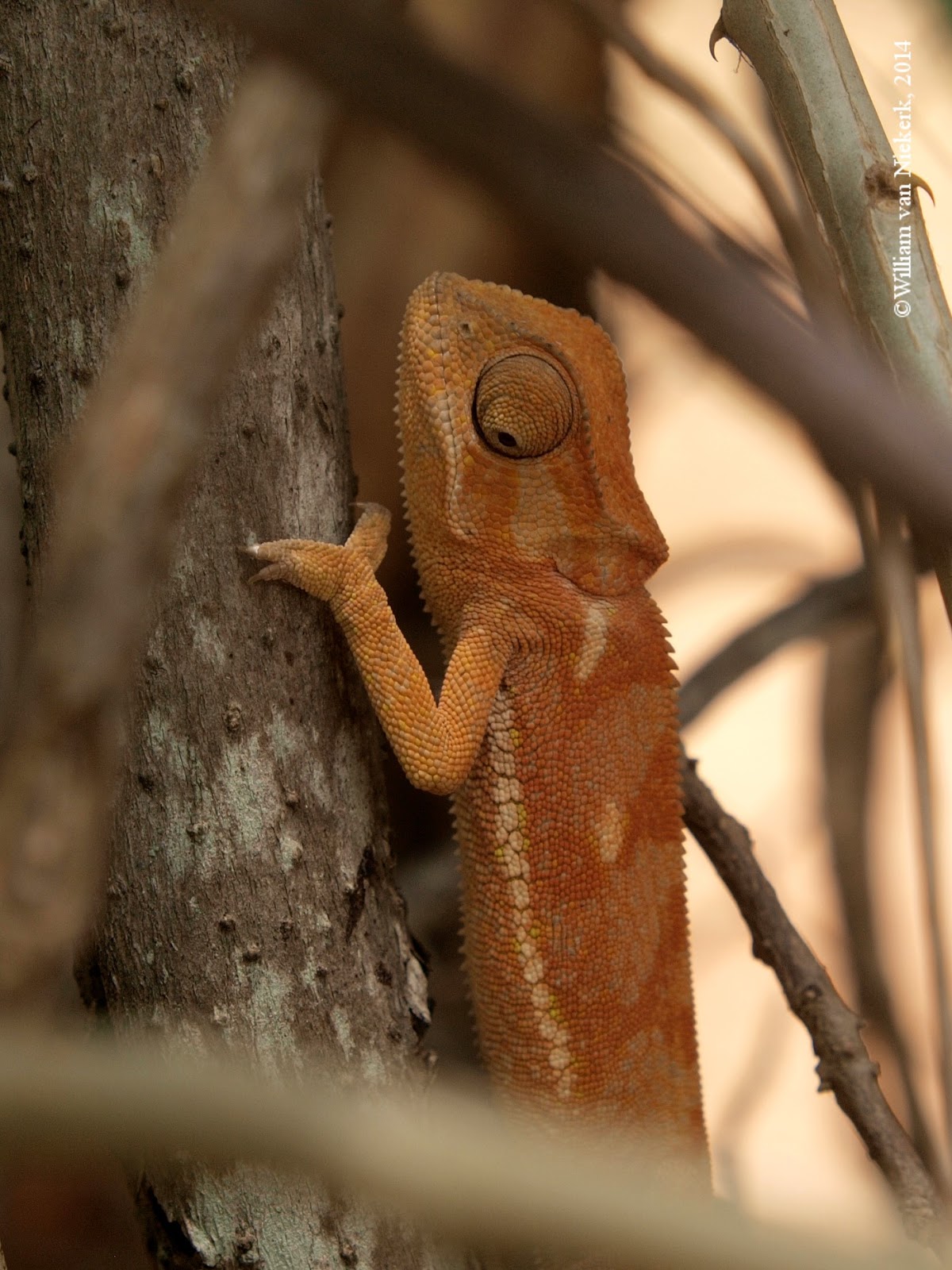
Smaller juveniles - like this hatchling from Chongwe - seem much happier on the ground than adults. This one was found sleeping on a grass-stalk a couple of feet above the waterlogged earth during a thunderstorm (only feet from the previously posted Zonocerus elegans) in January 2014.


Although individual colour changes are usually limited to darker or lighter tones of a base colour, with an increased apparency of dark stripes and spots being the common reaction to a human approach, the species displays an extraordinary diversity in individual colours; from rusty orange (Chongwe, October 2011)  to a lime green (Chongwe, March 2013):


Although abirimankhwe are generally of quite sensitive temperament, young individuals are often not overly concerned when handled - although the polka-dot appearance of the specimen in the right hand image is an indicator of stress, less than a minute later, it was comfortable enough to catch a grasshopper from its perch on my index finger.

Despite a dark spotting being associated with distress, this large female - bright green and darkly spotted when found trying to hide from passing cars on a road, fading to a leafy green before her release - seemed to grow darker as she headed for the canopy of a large tree, in a quite different pattern to her (not photographed) distress speckles:


Photographed in Chongwe, Lusaka, Zambia in September 2011,
using Olympus E-420 DSLR and 40-150mm Zuiko lens.

And with that rather lengthy preamble, and a record six pictures in one post, on with the taxonomy:

- Chamaeleoninae
- Chameleonidae    
- 'Acrodonta'            
 A bit of a questionable taxon, but see also Agama armata
 - Iguania                      
As noted in a recent reptile post, things get iffy and unsatisfactorily named here. The next grouping on from Iguania is with snakes and allied groups - for which see also Psammophis mossambicus and Thelotornis capensis; and thereafter with the Skinks and wall lizards (e.g. Afroablepharus wahlbergii, Trachylepis varia ,Trachylepis striata wahlbergi and Zootoca vivipara) and eventually the geckos (for example Lygodactylus capensis). This completes the:
- Squamata                       
- Lepidosauria                   
- Lepidosauromorpha         
- Sauria                                 
- Diapsida                                  
- Romeriida                                 
- Reptilia                                      
- Amniota                                      
- Reptiliomorpha                             
- Tetrapoda                                       
- Sarcopterygii                                    
- Osteichthys                                       
- Teleostomi                                          
- Gnathostomata                                     
- Vertebrata                                              
- Craniata                                                  
- Chordata                                                  
- Deuterostomia                                           
- Nephrozoa                                                   
See also Nephila fenestrata, Enoplognatha ovata, Argiope bruennichi, Alopecosa barbipes, Phrynarachne rugosa, Hyllus argyrotoxus, Enoplognatha ovata, Argiope bruennichi, Pardosa amentata, Dysdera crocata, Dicranopalpus ramosus, Ligia oceanica, Dichtha inflata, Oedemera nobilis, Otiorhynchus atroapterus,Malachius bipustulatus , Phyllobius pomaceus, Cheilomenes lunata, Melolontha melolontha, Neojulodis vittipennis, Demetrias atricapillusAnthia fornasinii, Lophyra cf. differens, Synagris proserpina, Vespula germanica, Astata tropicalis, Anthophora furcata, Andrena nigroaenea, Zebronia phenice, Crambus pascuella, Nemophora degeerella, Sphinx ligustri, Laelia robusta, Acada biseriata, Metisella willemi, Anthocharis cardamines, Papilio demodocus, Panorpa germanica, Chloromyia formosa, Senaspis haemorrhoa, Helophilus pendulus, Episyrphus balteatus, Metadon inermis, Diasemopsis meigeniiDolichotachina caudata, Megistocera filipes, Pephricus, Grypocoris stysiRanatra, Anoplocnemis curvipes, Idolomantis dentifrons, Sibylla pretiosa, Tettigonia viridissima, Stictogryllacris punctata, Enyaliopsis, Zonocerus elegans, Humbe tenuicornis, Lobosceliana loboscelis, Cyathosternum prehensile, Heteropternis thoracica, Pseudothericles jallae, Enallagma cyathigerum, Pseudagrion hageni, Lestinogomphus angustus, Rhyothemis semihyalina, Orthetrum brachiale and Burtoa nilotica.
  - Bilateralia                                                        
- Eumetazoa                                                        
- Animalia                                                             
- Eukaryota                                                            

And that's all folks!


My sister, whose primary vocations are more creative than mine by far, also has a thing for chameleons, and much of her art - including several commissions - features these wonderful lizards.
See a limited selection of her artwork online at laurenvanniekerk.artweb.com


Friday, 2 May 2014

Nephila fenestrata, Thorell, 1859, or possibly N. senegalensis (Walckenaer, 1842), and a warning for the phobics.

I have mentioned before that I'm quite fond of spiders, and it's probably been apparent in those posts that I am a touch unsympathetic towards people who have worked themselves up so much about something essentially harmless that they'll even hide from an image...

I wasn't always that way. When I was about 8 years old, my dear uncle informed me that the brownish spiders building their webs in the shower were close relatives of the black widow, known as brown button spiders and possessing extremely potent venom. This wasn't entirely dissimilar to something bearing a resemblance to the truth, and this little seed of information threatened to grow into a full blown phobia, before I gained a house-mate who overreacted to wasps in much the same way.

Nevertheless, as this is a member of one group of spiders that I still would be quite uncomfortable handling, I will give spider-fearing men - and women - fair warning: You might not want to look at the pictures.

I will leave it up to you whether you let an irrational fear own you, or take that fear and punch it repeatedly in the face, saying 'Hey, you, fear! Listen up - spiders are extraordinary and valuable members of society, and even if I don't want to touch them, I'm not going to freak out over a bunch of pixels on the interweb. Yeah, I said web, fear, because I'm not afraid of pixellated silk!'

Or something to that effect.

I think that's enough pre-amble that real fraidy-cats should be able to click away without seeing the Kanguade (Chewa for spider) of the day:


You may notice that the pictures on this post are without caption; they are all taken in Chongwe, Lusaka, Zambia, scattered through February and March 2013, although the spider itself is present from the middle-to-late rains (in the late season of the 2013-14 rains, they only showed up in Chongwe in December), and usually persist until July or August.

Unfortunately, this means that all these photographs feature incompletely mature individuals, which can make I.D. a little tricky. For example:

The distinct yellow 'window' on the underside of this little lady would comfortably identify her as

Nephila fenestrata
Thorell, 1859

Also known as the black-legged Nephila (The genus' actual common name, 'Golden Orb-Weaver' is longer than the genus name itself, so we'll stick with Nephila), or Windowed Nephila which has a number of subspecies - and some pictures online certainly resemble this series, but whether those actually belong to this species, or are just hopeful I.D.s by people who've taken the stance that this is more windowed and black legged than it is red-legged or banded legged (the two most promising alternative species; also, in a not entirely unrelated note, the other two species present in numbers in South Africa, arguably the most comprehensively-studied microfauna in Sub-Saharan Africa)

But both these pictures were taken in shady areas, which necessitated the use of partial flash - which masks the translucency of parts of these oversized spiderlings' (okay, a little beyond spiderling) bodies. Which brings us to the third picture: 


This one, as you can probably tell, was caught in early-morning sunlight, which didn't simply allow us to see the transparency of the legs, but it's exaggerated it somewhat, while, to an extent, masking the brushes of dark red hair on three pairs of legs; without that, it seems as though it could grow into an adult Nephila inaurata, or Red-legged Nephila (it can't - there are other more convincing differences in colour and range). 

Even with the brushes, it's not an excessive stretch of the imagination to translate this to the colouring of Nephila senegalensis, which other people of uncertain credentials have done online. 

And, if we take a look at this larger subadult - losing a battle to a Sphecid wasp (probably Sceliphron sp.), we see more of that non-black colouring on the legs: 


The windowing of the abdomen is also reduced to two yellow lines, and the ratio of black to orange on the palp - the little mouth-leg held in the wasps mandibles - is different from each of those seen in the younger individuals already shown, but - as with all the individuals photographed, the femorae (first long bit) of all legs are black - whereas in all images of N. senegalensis I can find on the web or in my (rather limited) books, from Kenya to South Africa, the last (and usually second last) femur is orange-red. 


Two things prevent me from ruling out either of these species. 

1) They are known to be variable, and patterns in adults aren't always readily extrapolated from subadult patterns.

2) It's possible that, despite the saturation of the environment to the point that the dense populations of these spiders weren't separated by more than two or three metres within the entire area these were photographed, there were multiple species, and possibly even hybrids, in the mix.

Until I go out for longer, and get a more continuous series of photographs of the a specific web-group over time and into adulthood (Wasps' and Bulbuls' appetites permitting), I will favour N. fenestrata for these images, but be unable to rule out N. senegalensis. 

I'll add the taxonomy tomorrow - now, with a quick illustration of why these are known as Golden Orb Weavers, I'm off to bed. Behold their silk: 


Yup. It's a rich yellow colour, poetically known as gold. Not really noticeable on fine strands most of the time, but on the thicker threads that anchor the webs, it's a handy clue that you're looking at Nephila.


And, for now, that's all, folks: Goodnight.

Additional: here's the taxonomy.


- Nephilidae                     
- Araneoidea                      

- Entelegynae                       
- Araneoclada                        
See also Dysdera crocata
- Neocribellatae                       
- Araneomorphae                       
- Opisthothelae                             
- Araneae                                        
- Megoperculata                                
- Micrura                                              
- Arachnida                                            
See also Dicranopalpus ramosus
- Chelicerata                                            
- Arthropoda                                             
See also Ligia oceanica, Dichtha inflata, Oedemera nobilis, Otiorhynchus atroapterus,Malachius bipustulatus , Phyllobius pomaceus, Cheilomenes lunata, Melolontha melolontha, Neojulodis vittipennis, Demetrias atricapillusAnthia fornasinii, Lophyra cf. differens, Synagris proserpina, Vespula germanica, Astata tropicalis, Anthophora furcata, Andrena nigroaenea, Zebronia phenice, Crambus pascuella, Nemophora degeerella, Sphinx ligustri, Laelia robusta, Acada biseriata, Metisella willemi, Anthocharis cardamines, Papilio demodocus, Panorpa germanica, Chloromyia formosa, Senaspis haemorrhoa, Helophilus pendulus, Episyrphus balteatus, Metadon inermis, Diasemopsis meigeniiDolichotachina caudata, Megistocera filipes, Pephricus, Grypocoris stysiRanatra, Anoplocnemis curvipes, Idolomantis dentifrons, Sibylla pretiosa, Tettigonia viridissima, Stictogryllacris punctata, Enyaliopsis, Humbe tenuicornis, Lobosceliana loboscelis, Cyathosternum prehensile, Heteropternis thoracica, Pseudothericles jallae, Enallagma cyathigerum, Pseudagrion hageni, Lestinogomphus angustus, Rhyothemis semihyalina and Orthetrum brachiale
- Ecdysozoa                                                
- Protostomia                                                
See also Burtoa nilotica
- Nephrozoa                                                     
- Bilateralia                                                            
- Eumetazoa                                                            
- Animalia                                                                 
- Eukaryota                                                                


And now that really is all, folks!


Note: 

Other African Nephila not discussed within the text: 

N. comorana - not found on the mainland.
N. constricta - seems to have hairless legs, a la N. inaurata.
N. komaci - described as having a long, broad abdomen, a very distinctive colour pattern and a disjunct range.
N. pilipes  - in Africa, found only in Madagascar and associated islands.
N. sumptuosa - has a long, broad abdomen, unlike those seen in adults in and around Lusaka.
N. turneri - although range unclear, very distinctively coloured.


Although not particularly user-friendly, and there are definitely a few images that have been incorrectly assigned, the South African National Survey of Arachnids Virtual Museum is probably the most ambitious resource currently freely available for the full diversity of African Arachnids. It's worth noting that, given the shortage of information on this group, that's not as prestigious as it sounds.


Wednesday, 23 April 2014

Agama armata (Peters, 1855) - and St. George's Day.

So it's that time of year again - the day when the British all get in a hoo-hah over some long-dead gentleman slaying an alleged dragon. While the more sensible sources suggest that he actually slew a crocodile - and didn't even eat it - that had been terrorizing villagers (i.e. eating them), I maintain that he slew a less impressive lizard, made terrible by right-wing religious zealots in their war against all things scaly.

That's a little bit beside the point, really, so to make up for it, here's a member of the family of reptiles most widely referred to as dragons:

Photographed in Chongwe, Lusaka, Zambia in December 2013, using Olympus E-420 DSLR with Zuiko 70-300mm Telephoto lens.
As a child, I always called these little lizards by the Afrikaans Goggomanikes, although I'll confess that I still don't quite know how to spell that; with the related Blueskop (again, spelling may be an issue), these were some of the most common lizards of my childhood that were clearly neither skinks nor geckos - although based on a rather vague drawing, when I first tried to identify these beyond the Afrikaans, I thought they were Bibron's geckos.

I was about six, so I've forgiven myself. They're actually, for the English-Speaking world, Agamas (alright, that's not originally English, but it's been subsumed internationally, so it counts) - perhaps best known by Australian representatives such as Pogona vitticeps, (Warlpiri - Japantarra / Mantalyarrpa; English - Central Bearded Dragon).

Back to the story, these once common lizards have not fared all that well in the Lusaka area. While this species remains common in parts of the outskirts, it quickly disappears in areas where ants are being poisoned (much like the more synanthropic gecko Lygodactylus (cf) capensis featured around St. George's last year) and neither this nor the (unfeatured) blueskop survives any real density of the domestic cats.

It doesn't help that two longish teeth at the front of their jaws look a little bit like tiny fangs, and have created an urban myth that their bite is highly venomous. In the unlikely event that they are, the delivery of the venom is unimpressive - for aggressive though they are when handled, they've yet to cause any deaths. That doesn't stop them being beaten to death on sight in many areas of Lusaka, however.

If you are lucky enough to have these in your garden, please, please, please, don't beat them to death. Keep any cats indoors or under control - an invisible fence and electric collar combination might seem cruel, but in addition to protecting your wildlife in the excluded areas of your garden, it will also stop your cat ending up as roadkill. So it's win-win, really.

To break up that rather lengthy monologue, here's another picture:

Same lizard, same place, same day. Same camera, too, but with a low flash to give a little more light - hence weird shadows.
Based on their distinctive breeding behaviour of climbing up tall objects and waving their heads about, these have earned the Chewa/Nyanja name of Dududu. In English, with the note that a word widely by English speakers in countries far from its origin counts as English, this is a Spiny or Ground Agama. Depending where you draw the species line, it should be Peters' Spiny Agama,

Agama armata*
(Peters, 1855)

And, as touched upon in the earlier block of endless text, is harmless and  really quite valuable ant control. 


And, with all that dispensed with, let's have a peek at the taxonomy: 

 
 - Agaminae       
 - Agamidae         
- Acrodonta          
- Iguania                  
- Squamata                
- Lepidosauria             
-  Lepidosauromorpha   
- Sauria                            
- Romeriida                          
- Reptilia                                
- Amniota                                
- Reptiliomorpha                        
- Tetrapoda                                  
- Sarcopterygii                                
- Osteichthys                                    
- Teleostomi                                        
- Gnathostomata                                   
- Vertebrata                                             
- Craniata                                                  
- Chordata                                                  
- Deuterostomia                                           
- Nephrozoa                                                   
See also Burtoa nilotica, Alopecosa barbipes, Ligia oceanica, Dysdera crocata, Phrynarachne rugosa, Hyllus argyrotoxus, Enoplognatha ovataArgiope bruennichi, Pardosa amentata, Dicranopalpus ramosus, Eremoides bicristatus, Hagenomyia tristis, Dichtha inflata, Oedemera nobilis, Otiorhynchus atroapterus,Malachius bipustulatus , Phyllobius pomaceus, Cheilomenes lunata, Melolontha melolontha, Neojulodis vittipennis, Demetrias atricapillusAnthia fornasinii, Lophyra cf. differens, Synagris proserpina, Vespula germanica, Astata tropicalis, Anthophora furcata, Andrena nigroaenea, Zebronia phenice, Crambus pascuella, Nemophora degeerella, Sphinx ligustri, Laelia robusta, Acada biseriata, Metisella willemi, Anthocharis cardamines, Papilio demodocus, Panorpa germanica, Chloromyia formosa, Senaspis haemorrhoa, Helophilus pendulus, Episyrphus balteatus, Metadon inermis, Diasemopsis meigeniiDolichotachina caudata, Megistocera filipes, Pephricus, Grypocoris stysiRanatra, Anoplocnemis curvipes, Idolomantis dentifrons, Sibylla pretiosa, Tettigonia viridissima, Stictogryllacris punctata, Enyaliopsis, Humbe tenuicornis, Lobosceliana loboscelis, Cyathosternum prehensile, Heteropternis thoracica, Pseudothericles jallae, Enallagma cyathigerum, Pseudagrion hageni, Lestinogomphus angustus, Rhyothemis semihyalina and Orthetrum brachiale.
- Bilateralia                                                            
- Eumetazoa                                                            
- Animalia                                                                 
- Eukaryota                                                                

And that, I believe, is all, folks!


* A. armata  was formerly considered a subspecies of the Spiny Agama, A. aculeata. Branch (Snakes and Reptiles of Southern Africa) gives length of tail as a distinguishing character; elsewhere the striped throat of A. aculeata is treated as more useful; this specimen has a faintly speckled or very lightly reticulated throat, in keeping with A. armata, but a tail somewhat longer than head and body combined, which would support A. aculeata. As references to A. aculeata being resident to Zambia do not seem to take into account the splitting of the species, and in some cases refer specifically to the A.aculeata armata subspecies, and this was photographed so close to the  capital, it is taken on the balance that this is the species named in the text, and not A. aculeata. But be aware that I could be very wrong.