Showing posts with label Chewa. Show all posts

Friday, 9 May 2014

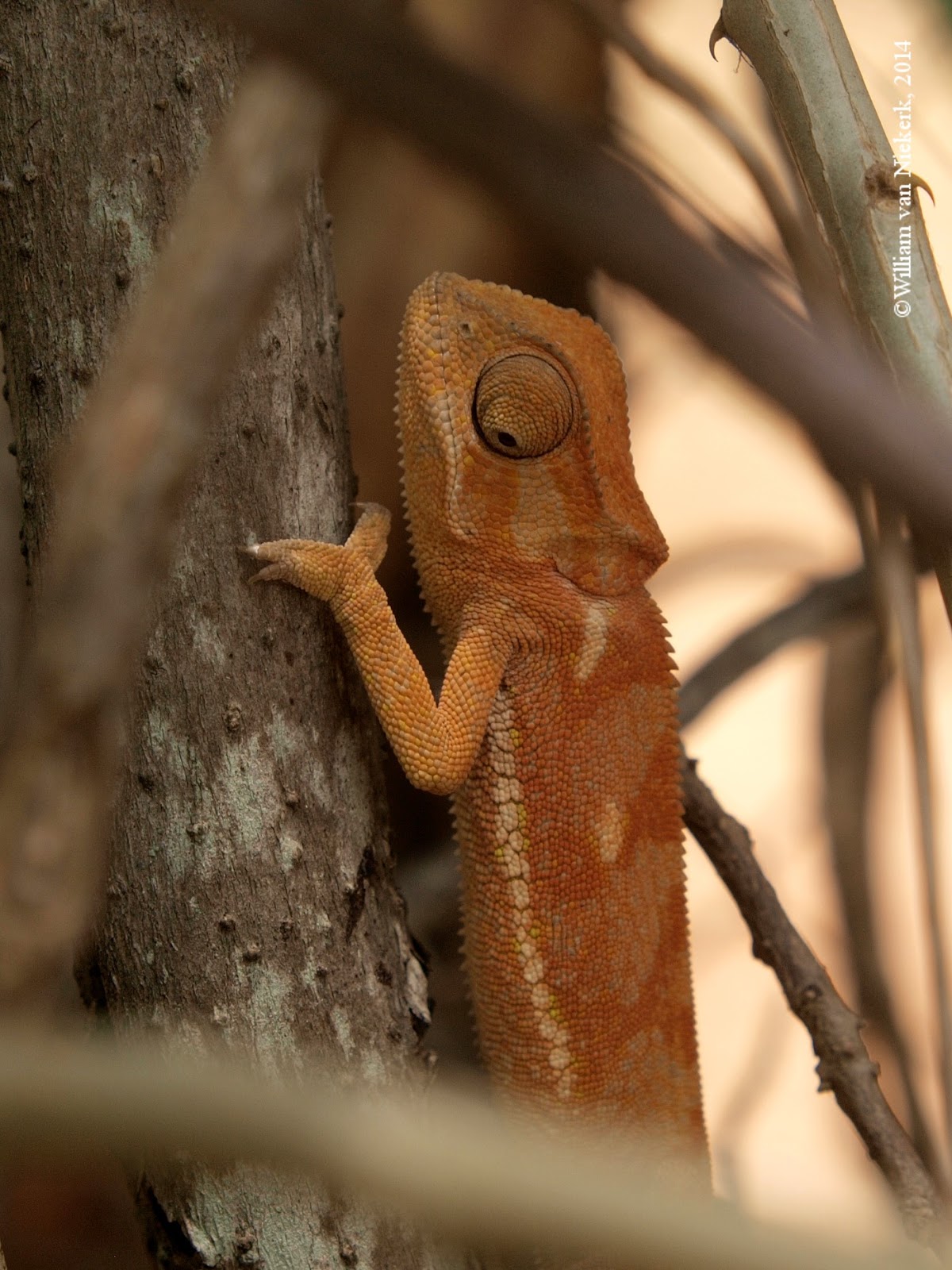
Chamaeleo dilepis, Leach, 1819

Welcome to a bit of a picture heavy post.

This lovely lizard is the subject of a bit of a family obsession:

Photographed in Chongwe, Lusaka, Zambia in December 2013, using Olympus E-420 DSLR
and Zuiko 70-300 telephoto lens.

As far as current knowledge goes, this is the only member of its family native to the Lusaka area. A significant chunk of my school time was spent retrieving these lizards from the centre of a panicked crowd and removing them to a safe distance.

There is a widespread distrust of chameleons in Sub-Saharan Africa - in Lusaka, the traditional myth seems to be that if you are bitten, you are cursed and one of your family is going to die. In the city, this is generally transmuted to their being highly venomous, or harbouring deadly bacteria on their teeth - All of which is patently not true. An angry specimen, with sharply defined markings and throat inflated to show brightly coloured skin usually hidden in folds, can look quite imposing, but having handled countless terrified individuals through my life, and been bitten well over twenty times (my father, notably, once demonstrated their harmlessness by allowing one to bite him on the tongue), I can confirm that it's bite is less painful and no more dangerous than being pinched by someone with medium-length fingernails. 

Have a look at another individual pretending to be twig while I babble about language:


Chongwe, Lusaka, Zambia in October 2011, using
Olympus E-420 with 40-150mm Zuiko lens


I'm not familiar with any Afrikaans names for this creature - a Chewa term is Birimankhwe, considering the more-or-less interchangeable nature of  'L' and 'R' in many Zambian dialects, its Soli name of Bilimankhwe is essentially identical. Kalilombe and Likakatuwe (both Chewa) are usually for larger specimens; Nanzikambe and Tonkhwetonkhwe are also listed by my Chewa dictionary, although I don't recall hearing either of these, or Likakatuwe, in use.


A closely related species is present in southern parts of Europe; in Spanish, Camaleón, which is more-or-less representative of most European names for this lizard (including the English Chameleon).

Further east, a number of species are found on the Indian subcontinent, and the Tamil  பச்சோந்தி

(~Pachonti) is possibly my favourite non-Zambian name.

The only species known to be present over much of Zambia, and extending across most of Sub-Saharan Africa, in English this is known as the Flap Necked Chameleon; internationally, it is most reliably referred to by its Linnaean binomial, which is:

Chamaeleo dilepis
 Leach, 1819


As previously noted, no other Chameleon species are known from most of Zambia (with the exception of a Nyika plateau endemic) - which, given the diversity of species in East Africa and Southern Africa, is possibly due to a lack of any real study rather than a missing diversity. Tellingly, in a country which is naturally forested, the only known chameleon is one of the least forest-dependent of the non-dwarf chameleons, and may simply have been the only species to survive widespread deforestation - often by fire in the inhabited portions of the country.


Although it is most readily encountered moving between trees, it is not limited to . Eggs, as with several other chameleon species, are buried underground, and, in areas with a marked winter season, won't hatch until a year later.

Smaller juveniles - like this hatchling from Chongwe - seem much happier on the ground than adults. This one was found sleeping on a grass-stalk a couple of feet above the waterlogged earth during a thunderstorm (only feet from the previously posted Zonocerus elegans) in January 2014.


Although individual colour changes are usually limited to darker or lighter tones of a base colour, with an increased apparency of dark stripes and spots being the common reaction to a human approach, the species displays an extraordinary diversity in individual colours; from rusty orange (Chongwe, October 2011)  to a lime green (Chongwe, March 2013):


Although abirimankhwe are generally of quite sensitive temperament, young individuals are often not overly concerned when handled - although the polka-dot appearance of the specimen in the right hand image is an indicator of stress, less than a minute later, it was comfortable enough to catch a grasshopper from its perch on my index finger.

Despite a dark spotting being associated with distress, this large female - bright green and darkly spotted when found trying to hide from passing cars on a road, fading to a leafy green before her release - seemed to grow darker as she headed for the canopy of a large tree, in a quite different pattern to her (not photographed) distress speckles:


Photographed in Chongwe, Lusaka, Zambia in September 2011,
using Olympus E-420 DSLR and 40-150mm Zuiko lens.

And with that rather lengthy preamble, and a record six pictures in one post, on with the taxonomy:

- Chamaeleoninae
- Chameleonidae    
- 'Acrodonta'            
 A bit of a questionable taxon, but see also Agama armata
 - Iguania                      
As noted in a recent reptile post, things get iffy and unsatisfactorily named here. The next grouping on from Iguania is with snakes and allied groups - for which see also Psammophis mossambicus and Thelotornis capensis; and thereafter with the Skinks and wall lizards (e.g. Afroablepharus wahlbergii, Trachylepis varia ,Trachylepis striata wahlbergi and Zootoca vivipara) and eventually the geckos (for example Lygodactylus capensis). This completes the:
- Squamata                       
- Lepidosauria                   
- Lepidosauromorpha         
- Sauria                                 
- Diapsida                                  
- Romeriida                                 
- Reptilia                                      
- Amniota                                      
- Reptiliomorpha                             
- Tetrapoda                                       
- Sarcopterygii                                    
- Osteichthys                                       
- Teleostomi                                          
- Gnathostomata                                     
- Vertebrata                                              
- Craniata                                                  
- Chordata                                                  
- Deuterostomia                                           
- Nephrozoa                                                   
See also Nephila fenestrata, Enoplognatha ovata, Argiope bruennichi, Alopecosa barbipes, Phrynarachne rugosa, Hyllus argyrotoxus, Enoplognatha ovata, Argiope bruennichi, Pardosa amentata, Dysdera crocata, Dicranopalpus ramosus, Ligia oceanica, Dichtha inflata, Oedemera nobilis, Otiorhynchus atroapterus,Malachius bipustulatus , Phyllobius pomaceus, Cheilomenes lunata, Melolontha melolontha, Neojulodis vittipennis, Demetrias atricapillus, Anthia fornasinii, Lophyra cf. differens, Synagris proserpina, Vespula germanica, Astata tropicalis, Anthophora furcata, Andrena nigroaenea, Zebronia phenice, Crambus pascuella, Nemophora degeerella, Sphinx ligustri, Laelia robusta, Acada biseriata, Metisella willemi, Anthocharis cardamines, Papilio demodocus, Panorpa germanica, Chloromyia formosa, Senaspis haemorrhoa, Helophilus pendulus, Episyrphus balteatus, Metadon inermis, Diasemopsis meigenii, Dolichotachina caudata, Megistocera filipes, Pephricus, Grypocoris stysi, Ranatra, Anoplocnemis curvipes, Idolomantis dentifrons, Sibylla pretiosa, Tettigonia viridissima, Stictogryllacris punctata, Enyaliopsis, Zonocerus elegans, Humbe tenuicornis, Lobosceliana loboscelis, Cyathosternum prehensile, Heteropternis thoracica, Pseudothericles jallae, Enallagma cyathigerum, Pseudagrion hageni, Lestinogomphus angustus, Rhyothemis semihyalina, Orthetrum brachiale and Burtoa nilotica.
  - Bilateralia                                                        
- Eumetazoa                                                        
- Animalia                                                             
- Eukaryota                                                            

And that's all folks!


My sister, whose primary vocations are more creative than mine by far, also has a thing for chameleons, and much of her art - including several commissions - features these wonderful lizards.
See a limited selection of her artwork online at laurenvanniekerk.artweb.com


Saturday, 3 May 2014

Psammophis mossambicus (Peters, 1882) and a lengthy ramble on reptile taxonomy.

I think it's worth telling you that I am terrified of a fair few things.

One is being alone in water deeper than a foot. Crocodiles are another. Sharks were, for a while, and it's not unreasonable to suppose that the cold dread I experience when I'm swimming in a murky creek without anyone to use as a human shield is because I watched Jaws well before I was old enough.
I'm scared of being trapped in a crowd - hearing more than a couple of simultaneous conversations nauseates me. I'm not comfortable sharing silence with strangers - when I was alone in a windowless lab with a lovely Welsh girl, working on my BSc dissertation study while she worked on her MRes, I was absolutely terrified of her until we broke our respective silences, and I knew that she wasn't just sitting there judging me and/or plotting to kill me somehow
I don't like having people in my blind spot, even if they are talking. I love cliff-top walks, but if I'm within four feet of the edge and I have my shoes on, I find it extremely difficult to step forward (as an aside, if I find myself within six or so feet of water that may contain a crocodile, I have quite the opposite response, and find it difficult to stop running).
I get nervous around powertools - too many scary movies too early - and the sound of trains in the dark. Dogs I don't know, other people's parents, other people's spit, rollercoasters, the Knife-Edge bridge at Mosi-oa-tunya, touching food that other people will eat... I could go on.

This, though, is something that has never been an issue for me:

Photographed in Chongwe, Lusaka, Zambia in August 2011, using an Olympus E-420 DSLR and a Zuiko 40-150mm lens.

Europe doesn't have many snakes; Britain has only three, and as you might expect from this, not until really quite recently has it expanded its vocabulary to include species-specific names - even words such as the Greek-rooted 'Python' have only been in English for a couple of centuries.

Zambia has around seventy species of snake, some of which are harmless, some of which are potently venomous - some of which again will bite readily if they perceive a threat, some of which are unwilling to bite even if trodden on. Some will raise a hood and spit at people a few metres away but flee from people close by, similar species will raise a hood but not spit at a certain distance, but just strike if surprised close to.

The long and short of this is that there are a lot of words for specific snakes in Chewa and its sister-languages. The mildly venomous (nausea and mild to intense pain) species pictured above has the name of Chidyamsana in Chewa, or the Olive Grass Snake, Mozambique Whip-Snake or Mozambique Whip-Snake in English.

It's quite retiring, as one might expect from a small, thin snake, but if cornered will capitalise on its resemblance to the not-too-distantly related Black Mamba (Dendroaspis polylepis), and strike readily. As noted, it's not absolutely harmless, and with a good bite, could make you feel fairly sorry for yourself for a while, but, allergic or psychosomatic reactions notwithstanding, it's far from deadly.

Unfortunately, that resemblance that sometimes means it can send its attackers running now often leads this handy member of the suburban rodent - and indeed snake - control crew to be hacked to death.

Although it is readily confused with smaller specimens of the (much bigger) black mamba, it's shape is quite unlike it - very slender, and often appearing much longer than it actually is as a result, it more closely resembles the arboreal (and rarely seen) green mambas in form; its head, if seen from any angle other than the front, is easily distinguished by its short, pointed form (as opposed to the elegant elongated octagon of a mamba's head, aptly described as 'coffin-shaped' from above). Behold:


It might be better if I had a picture of a mamba to compare it to - I don't, but ARKive hosts a number of pictures (click here to visit them) of the species, which show the difference quite clearly.


With those points covered, it's probably time for the taxonomy. The snake itself is

Psammophis mossambicus
(Peters, 1882)

But from here on, it can get messy.  

Snake taxonomy, by the way, is made atrocious by the existence of that enormous waste-bin taxon heretofore known as the family Colubridae, and in an attempt to reflect the actual relationships between snake species, I seem to be using a taxonomy that isn't necessarily used anywhere else; I put this lovely snake in the:
- Psammophiidae
 which is usually treated as a subfamily of the troubling family Lamprophiidae - which is itself still treated by some as a subfamily of the afore-mentioned Colubridae. I'm treating them instead as a sister family within the
- Elapoidea                 
(along with all manner of snakes we'll be discussing in later posts). This is united with the majority of familiar snakes in the:
- Caenophidia              
which does include the various colubrids - although most are venom-less constrictors, the only one featured on the blog thus far is the venomous  Thelotornis capensis. These are united with the boas and pythons in the  
- Alethinophidia        
  which excludes only a very few rather divergent members of the larger:
- Serpentes                  
Which are somewhere in the taxonomic mess otherwise known as the
-Squamata                     
Within which, the snakes cluster with the iguanians (such as Agama armata ), followed by the skinks and wall lizards (e.g. Afroablepharus wahlbergii, Trachylepis varia ,Trachylepis striata wahlbergi and Zootoca vivipara) and eventually the geckos (for example Lygodactylus capensis). All this falls within the:
- Lepidosauria                   
of which the only other extant group is the New Zealand endemic order Rhynchocephalia, the two species of Tuatara.
- Lepidosauromorpha          
- Sauria                                 
Although after this, the taxonomy gets a little more straightforward, this contains the Archosaurs (Crocodiles and dinosaurs, including birds such as Caprimulgus pectoralis, Tockus alboterminatus, Larus argentatus, Sterna hirundo, Burhinus vermiculatus, Troglodytes troglodytes, Megaceryle maxima, Ardea goliath, Chalcophaps indica and Stigmatopelia senegalensis), and should really include the Anapsids - tortoises, turtles and various dead relatives. But that's another story. 
- Diapsida                                  
- Romeriida                                 
- Reptilia                                      
- Amniota                                      
- Reptiliomorpha                             
- Tetrapoda                                       
- Sarcopterygii                                    
- Osteichthys                                       
- Teleostomi                                          
- Gnathostomata                                     
- Vertebrata                                              
- Craniata                                                  
- Chordata                                                  
- Deuterostomia                                           
- Nephrozoa                                                   
See also Nephila fenestrata, Enoplognatha ovata, Argiope bruennichi, Alopecosa barbipes, Phrynarachne rugosa, Hyllus argyrotoxus, Enoplognatha ovata, Argiope bruennichi, Pardosa amentata, Dysdera crocata, Dicranopalpus ramosus, Ligia oceanica, Dichtha inflata, Oedemera nobilis, Otiorhynchus atroapterus,Malachius bipustulatus , Phyllobius pomaceus, Cheilomenes lunata, Melolontha melolontha, Neojulodis vittipennis, Demetrias atricapillus, Anthia fornasinii, Lophyra cf. differens, Synagris proserpina, Vespula germanica, Astata tropicalis, Anthophora furcata, Andrena nigroaenea, Zebronia phenice, Crambus pascuella, Nemophora degeerella, Sphinx ligustri, Laelia robusta, Acada biseriata, Metisella willemi, Anthocharis cardamines, Papilio demodocus, Panorpa germanica, Chloromyia formosa, Senaspis haemorrhoa, Helophilus pendulus, Episyrphus balteatus, Metadon inermis, Diasemopsis meigenii, Dolichotachina caudata, Megistocera filipes, Pephricus, Grypocoris stysi, Ranatra, Anoplocnemis curvipes, Idolomantis dentifrons, Sibylla pretiosa, Tettigonia viridissima, Stictogryllacris punctata, Enyaliopsis, Humbe tenuicornis, Lobosceliana loboscelis, Cyathosternum prehensile, Heteropternis thoracica, Pseudothericles jallae, Enallagma cyathigerum, Pseudagrion hageni, Lestinogomphus angustus, Rhyothemis semihyalina, Orthetrum brachiale and Burtoa nilotica.
  - Bilateralia                                                        
- Eumetazoa                                                        
- Animalia                                                             
- Eukaryota                                                             


And, taking the first exit I can see at this point, that is all, folks! 


Friday, 2 May 2014

Afroablepharus wahlbergi, Smith, 1849.

It's been longer than I intended; you see, for a couple of weeks, the only pictures I've been wanting to post have been ones of reptiles and amphibians from Lusaka. Which could turn into a bit of a tiring tour of (non-avian) reptiles and amphibians from Lusaka.

Today I had a revelation - it's my blog; it's my decision if I want to occasionally focus on a particular group for a period of time. And as I'm feeling more than a little bit homesick of late, meet today's guest:

Photographed in Chongwe, Lusaka, Zambia in December 2013, using Olympus E-420 DSLR Camera with Zuiko 40-150mm lens and 3 KOOD magnifiers.

 Yes, by the way, that is a lizard perched entirely upon the distal phalanx of a human finger. Here's another picture:


The phalanx in question is approximately 28 millimetres long, so this little customer was a touch over three centimetres including tail, probably just pushing 15 millimetres snout-to-vent length (a standard length measurement for a lot of reptiles). 

It's probably important to note that this isn't an adult. The adults are relative giants, at about the length of an entire finger.

These titchy little Buluzi (remember that generic Chewa word for lizard from this post on Trachylepis striata wahlbergi?) are most commonly noticed as a frantic rustly and a silver squiggle in leaf-litter; although they do have reasonably robust legs, they can escape predators much more effectively by swimming through their rotting playground than they can by running through it.

We'll attempt a translation of their English name to Chewa as Buluzi ndi Maso wa Njoka; paying even less heed to grammatical differences between English and other languages, that could be Njoka-Diso Buluzi.

It's probably easier to tell you that this is, to the English speaking world, a snake-eyed skink, specifically Wahlberg's Snake Eyed Skink. Yes, Wahlberg does pop up a lot in African herpetology.

Perhaps more universally (overlooking uncertain generic placement), it's binomial name is:

Afroablepharus wahlbergi
(Smith, 1849) 

or sometimes 

Panaspis wahlbergi
(Smith, 1849)
 
As I mentioned, the adults are most commonly noticed as they flee through the ground-cover at high speed, and as they are small, well hidden and not given to sticking around when something large approaches, can be difficult to photograph, even when they stop to peer back at the intruder through the leaflitter: 

Photographed in Chongwe, Lusaka, Zambia, in December 2013, using Olympus E-420 DSLR, Zuiko 40-150mm lens and 2 KOOD magnifiers.

They're called snake-eyed skinks, by the way, because they lack a moveable upper eyelid; like snakes, and the majority of geckos, they can't blink. 


With that fascinating tidbit, let's finish with a peek at the taxonomy: 

 - Lygosominae  
- Scincidae          
- Scincomorpha     
See also Zootoca vivipara.
- Scleroglossa          
- Squamata                
See also Agama armata. 
- Lepidosauria             
-  Lepidosauromorpha   
- Sauria                            
- Romeriida                          
- Reptilia                                
- Amniota                                
- Reptiliomorpha                        
- Tetrapoda                                  
- Sarcopterygii                                
- Osteichthys                                    
- Teleostomi                                        
- Gnathostomata                                   
- Vertebrata                                             
- Craniata                                                  
- Chordata                                                  
- Deuterostomia                                           
- Nephrozoa                                                   
See also Burtoa nilotica, Alopecosa barbipes, Ligia oceanica, Dysdera crocata, Phrynarachne rugosa, Hyllus argyrotoxus, Enoplognatha ovata, Argiope bruennichi, Pardosa amentata, Dicranopalpus ramosus, Eremoides bicristatus, Hagenomyia tristis, Dichtha inflata, Oedemera nobilis, Otiorhynchus atroapterus,Malachius bipustulatus , Phyllobius pomaceus, Cheilomenes lunata, Melolontha melolontha, Neojulodis vittipennis, Demetrias atricapillus, Anthia fornasinii, Lophyra cf. differens, Synagris proserpina, Vespula germanica, Astata tropicalis, Anthophora furcata, Andrena nigroaenea, Zebronia phenice, Crambus pascuella, Nemophora degeerella, Sphinx ligustri, Laelia robusta, Acada biseriata, Metisella willemi, Anthocharis cardamines, Papilio demodocus, Panorpa germanica, Chloromyia formosa, Senaspis haemorrhoa, Helophilus pendulus, Episyrphus balteatus, Metadon inermis, Diasemopsis meigenii, Dolichotachina caudata, Megistocera filipes, Pephricus, Grypocoris stysi, Ranatra, Anoplocnemis curvipes, Idolomantis dentifrons, Sibylla pretiosa, Tettigonia viridissima, Stictogryllacris punctata, Enyaliopsis, Humbe tenuicornis, Lobosceliana loboscelis, Cyathosternum prehensile, Heteropternis thoracica, Pseudothericles jallae, Enallagma cyathigerum, Pseudagrion hageni, Lestinogomphus angustus, Rhyothemis semihyalina and Orthetrum brachiale.
- Bilateralia                                                            
- Eumetazoa                                                            
- Animalia                                                                 
- Eukaryota