Friday, 28 June 2019

The Myrmeleontiform Lacewings (Neuroptera), OR No, it's not a weird dragonfly OR Insects and Agriculture part I of... many.

Palpares normalis Navás, 1911 (Neuroptera: Myrmeleontidae) in dry wooded slopes in the Mutinondo Wilderness Area, Muchinga Province, Zambia

So. 

    A while back I was very excited that the EU had issued a broad, long overdue ban on Neonicotinoid pesticides in Europe. 
This ban was not quite the starting gun for improved awareness of the value and increasing plight of insect communities that I might have hoped. 
    I recognise that the seeming progress created by the recent media coverage (here, there and everywhere) and UN Report on the matter may end up Anita Hill'd for a good twenty years, but here and now, I want to try to be positive. 

So


    I have an evil plan to save the world.
    Well, an evil plan to help people reduce their active efforts to unwittingly destroy the world, and give them an opportunity to give the world a little more opportunity to save itself. 


So 

    The next few posts are intended to focus on the roles that insects of different groups play in agriculture, something that I know from far more experience than I'd like is dangerously simplified by the public at large, even when the idea of a beneficial insect is actually floating around inside the heads of the farmers, farm managers, scouts, labourers et al.
    The plan is to rotate through an order of insects each month, using broad strokes to explain the roles and interactions between different groups. Because June is very nearly over, I'm going to start with a fairly small group that can be quite easily chunked into two (or three at the most) posts, beginning with a subgroup that can be very conspicuous, but aren't going to win any prizes for the mass of their impact: 


The Myrmeleontiform Lacewings
or 
No, it's not a weird dragonfly


The weirdly wonderful, and somewhat atypical, Cymothales sp. (Neuroptera: Myrmeleontidae) coming to lights in Chongwe, Lusaka Province, Zambia. Compare to the similarly odd and oddly similar Tmesibasis (Neuroptera: Ascalaphidae) further down. 

The suborder Myrmeleontiformia is one of two suborders usually included in the weird and wonderful - if rather small - order Neuroptera, and for the most part, if a non-enthusiast walking along would stop and go "Wow" at a lacewing, it's probably in this suborder. Probably.

If I was a paleontologist, which I'm not, the picture would be complicated by numerous long extinct (probably not because of humans) families. However, from where I sit, the Myrmeleontiforms are split into: 

Superfamily Myrmeleontoidea, which contains:
  • Family Myrmeleontidae, the Antlions
  • Family Ascalaphidae, the Owlflies (sometimes merged into Myrmeleontidae)
    and
  • Family Nymphidae, the Split-Foot Lacewings (Essentially the last survivors of a much more diverse, largely extinct group of lacewings. Mostly in Australasia, some to eastern Asia, none in Africa, which is probably good because I had to google them to be sure that they were actually Myrmeleontiform. We will not be discussing them any further today)
Superfamily Nemopteroidea, which is made up of:
  • Family Nemopteridae - Ribbon-Wing and Spoon-Wing Lacewings
  • Family Psychopsidae - the Moth Lacewings

It's not a coincidence that I listed the Myrmeleontidae first: they are almost universally the most abundant, and very much the most important, of any of these families, and we will therefore be discussing them first:


Ant-Lions of family Myrmeleontidae

Myrmeleon lethifer Walker, 1853, in woodland in the Mutinondo Wilderness Area, Muchinga Province, Zambia. 

Hagenomyia tristis (Walker, 1853) in woodland edge
 MutinondoWilderness Area, Muchinga Province, Zambia. 


The direct effects of these lacewings on agriculture are... not huge. Although they are the most abundant large lacewings, most species are still generally uncommon where they occur, and a diverse mix of species is probably more useful as an indicator of a healthy habitat than directly beneficial to the human users of that habitat. So, as a quick break-down for farmers:


Macroleon quinquemaculatus (Hagen, 1853) coming to
lights in  Chongwe, Lusaka Province, Zambia
Problems:

None. They don't damage crops or pester livestock, and where insects like fungus gnats also don't care about your crops or livestock but damage roots and spread diseases through sheer numbers, the most abundant lacewings just aren't numerous enough to do damage.


Benefits:


Macronemurus sp. in dry woodland near Chilinga,
Eastern Province, Zambia


Pollination?
Nope. I have my suspicion that genera such as Cymothales visit flowers while I'm not looking, but even if they spent all day fluttering between flowers, their natural populations are just too low to be effective pollinators.


Pest Control? A resounding YES. While all
species are predatory as larvae and predatory (or
non-feeding) as adults, it is really only a
handful of gregarious species like Hagenomyia tristis 
and Myrmeleon lethifer which ever reach the densities

Banyutus sp. coming to lights in Chongwe,
Lusaka Province, Zambia.
 needed to make any dent in the populations of unwelcome insects such as mosquitoes, fungus gnats 
and other weak-flying small insects. The larvae of
Hagenomyia and Myrmeleon are also a factor in
limiting movement of ants, termites and other small,
terrestrial insects - but most people who've spent any
time at all on any farm in Zambia will already have borne witness to an ant being dragged to a horror-
movie style ending by the large, sickle-shaped jaws emerging from the bottom of a conical pit...
Hagenomyia in particular forms dense aggregations of these tiny death-traps in sandy soils, which, while in
 itself not controlling ant or termite populations,
offers just one of the many angles of attack to keep
 them from taking over the world. Which is nice!


Neuroleon distinctus (Navás, 1931) in woodland edge in
Mutinondo Wilderness Area, Muchinga Provinca, 
Zambia.


And now for the post-amble: What, Where and Why Care? 

As much as they are not (at all) closely related,
Antlions are basically the dry-land alternative to dragonflies: The larvae are horror-movie 
monsters that just happen to torment other 
invertebrates instead of college-
students/babysitters/other assorted collections of industry-standard attractive people who make bad decisions and the adults are aerial predators that flit around in the undergrowth murdering all and sundry smaller insects that don't get out of their way. So... NOT weird dragonflies but they do act quite a lot like it.

Not only do they not depend on water, but most

Centroclisis sp. coming to lights in Chongwe,
Lusaka Province, Zambia.
groups actively require its absence for at least part
of their development: the steep sides of their iconic conical pits are a bit useless as an insect trap if they
are waterlogged and the ant can just walk out calmly
while the jaws of death throw mud-pies ineffectively around them. In wetter areas, pit-building antlions are
relegated to rain-shadows (which means that they are
often quite fond of the sandy areas under the eaves of houses - if only people would spend less time dousing these areas with insecticides, they might spawn huge numbers of natural born mosquito killers), and you tend to find more of the tree-hole dwelling Centroclisis.
In arid areas and on well-drained slopes, the striking Palpares become common; their larvae are
less industrious, and - as with many, many other
antlions - essentially swim through the sand in search
of anyone else to eat. 

Palparellus nyassanus (Navas, 1911) in dry scrub in
Livingstone, Southern Province, (Barotseland) Zambia. 


As much as any individual Antlion is basically a
 killing machine, their effects on populations of
smaller insects are probably not overwhelming.
However, where vertebrate ecosystems maintain
stability by having just a few, often territorial
predators, stability in invertebrate populations
instead relies on a vast network of different
predators and parasites - so if one predator's
 population has a bad year, prey species are kept
 in check by another.*

Another value, particularly to environmental researchers, is that these animals are excellent indicators: most are incredibly specialist in their breeding preferences (once more, I should add except Hagenomyia tristis), and are among the first to disappear entirely from fragmented habitats. First, and it astonishes me that there is not a lot more focus on lacewing groups during impact assessments as a result, animals whose numbers are naturally low tend to suffer disproportionately from something called Allee Effects, which we will discuss in our next group, the Owlflies.


Palpares cataractae Péringuey, 1910, on pseudo-arid
grassland slopes in Kundabwika falls Heritage site,
Northern Province, Zambia
Palpares schoutedeni Navás, 1925, in dry woodland on the
west bank of Kundabwika falls, Luapula Province, Zambia


Owlflies of family Ascalaphidae

The wonderfully weird Tmesibasis lacerata (Hagen, 1853) in woodland in the Mutinondo Wilderness Area,
Muchinga Province, Zambia. 


Problems: None (See above). 
Benefits: 
Pollination: No
Pest Control: No
So, farmers. The key thing to remember is that these insects are not your enemy. That said, the chances of you meeting any of them are... rather low. So on to the amble: 


What, Where and Why Care?
If Antlions are naturally uncommon, Owlflies are naturally scarce. They overlap broadly, but where Antlions are most abundant in open, arid environments, the owlflies tend to be more numerous (well, less completely absent) in wooded areas, where their young hunt for their victims much more actively, usually on tree-trunks and in leaf-litter. I personally find the larvae quite appealing, as murderous little fiends go, but I felt maternal watching a rat tapeworm (Hymenolepis) emerge from its cyst under a microscope, so my opinion on these matters does not count. The adults are broadly similar to antlions, but tend to be much more wary, and rather stronger fliers - a similar difference as you'd see between ancient Norsemen hunting whales from long-boats using spears and their 20th century descendants going out on a motorized rig with a harpoon gun.


Another difference is that they are never common. This isn't simply because their favoured habitats are under intense pressure in this part of the world** - they just seem to have naturally low population densities. 
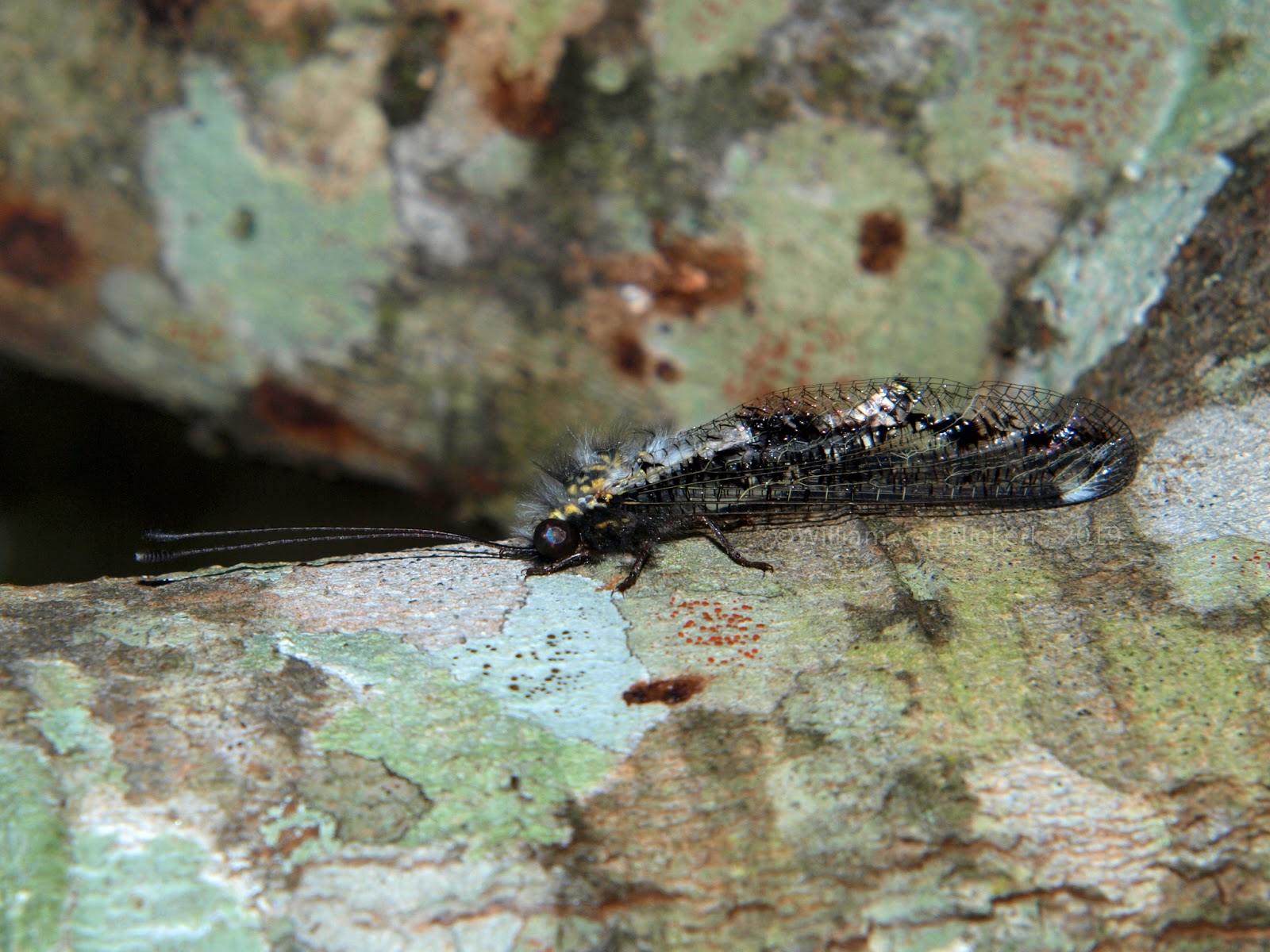
Allocormodes junodi van der Weele, 1909, in woodland in
Mutinondo Wilderness Area, Muchinga Province, Zambia. 
And this is where I get to talk about Allee Effects. Yay!

We're going to start with an analogy. We'll use people, because I'm told other people find them easier to relate to than Pyrenean Ibex, which we'll come back to later. We're going to start with a nice, average sample. 

Our imaginary, average sample of adult humans comprises 50 females and 50 males - well, almost (in most places, male embryos are less viable, and men tend to die younger).

Now say that this average sample of produces 100 offspring over their lifetimes, but instead of being nice and average, this sample is truly random; let's say that there are 61 males and 39 females. No big, right? Across the whole of our seven-point-something-billion-strong species there are enough babies being born to account for the shortage of females - no worries.

But what if those 50 men and 50 women were the only people?

Well, now it is a problem. We went from having 50

Ascalaphus festivus (Rambur, 1842) in grassland
in Chongwe, Lusaka, Zambia
 women, who produce an average of 2 children each
 in a generation, to having 39, who will probably
also produce an average of 2 children each (sorry,
males, but except in species like seahorses and
cardinalfish, you really don't matter when it comes to population dynamics).

So our third generation is comprised of just 78 people. Let's not even pretend that the law of averages is anything but a logical fallacy, and just accept that there is no improved chance of female offspring in this generation just because we had a shortage in the last one. We're looking at 50-50 odds, which means that, all things being equal, this is our new population size.

Now what if, by random chance, this third generation just happens to be low in females again? If out of 78, only 35 are female? Well, look at that, our population size just fell again.
And sure, any one of these generations could, by random chance, be overwhelmingly female, and then our population would go up again, but the point here is that chaos is unpredictable, and if we were to repeat our experiment enough times, we would find plenty of iterations where random chance
eventually produces an all-male generation and,
for reasons that should be obvious, that is the
Disparomitus longus Navás, 1911 in riparian forest below
Kabwelume falls, near Mporokoso, Northern Province, Zambia
end of that.

AND THEN lets give our imaginary population genetics. By chance, they might end up like the Eurasian Beaver, which managed to shed almost all its genetic weaknesses over generations of dwindling populations and inbreeding and can build a healthy, thriving population from just three individuals (eurgh), or more likely, generations upon generations of inbreeding means that every mating produces a larger proportion non-viable embryos or sickly offspring. This is even worse if our population of 100 are not mixing freely, but are spread out over their habitat, where they quickly become more likely to meet and mate with a relative than a non-relative.

Encyoposis seydeli (Navás, 1929) in dry woodland in
Mutinondo Wilderness Area, Muchinga Province, Zambia. 
AS IF THAT'S NOT ENOUGH, let's give them an environment. Say, for example, that they live in a forest where once a year a tree falls on someone, killing them****. The chances of this happening in a year where, by extremely bad luck, you're down to one female, AND it happening to that one female, are extremely remote, right?

Right. But random chance is random chance, and Celia, the last wild Bucardo (Capra pyreniaca pyreniaca - I told you we'd come back to the Pyrenean Ibex) got squished by a falling tree and her subspecies went extinct. Najin and Fatu, the last two female Northern White Rhinos (Ceratotherium simum cottoni) in the world have bad hips and a damaged uterus between them which render them both functionally infertile - even if the last male wasn't dead.


You get the picture. 

Now, imagine that we go back to seven billion people in the world. But for some reason - let's say, for example, scorching deserts that anyone who tries to cross dies - they are split into populations of an average size of... 100.

Remember this guy? Eremoides bicristatus (Banks, 1924)
 in grassland in Chongwe district, Lusaka, Zambia. 
In any given generation, about half of those populations will get more females than the generation before. About half will get less. Do you see where this is going?

This species is doomed. DOOMED, I say. DOOOOOOMED. :)

Each generation is tossing a coin for everything it has: half the time, they win, and the population increases a little, and they toss the coin again. Half the time, they lose, and then they do not toss the coin again. 

In a connected species, you can spread your winnings out, and toss the coin again even if you lost there, because you won somewhere else.

Enough analogies? Good. 

Because we are fragmenting other animals' populations without even knowing it. Cities, fields, roads, firebreaks, even footpaths present an impassable or near-impassable barrier to some species, and as our populations expand into more and more of the planet, environmental specialists find the parts of the planet that they can live in get
smaller and smaller as well as more and more
 isolated. This is the reason that there are constant
campaigns for corridor areas connecting national
Phalascusa cf. vassei van der Weele, 1909 in riverine
vegetation near Chilinga, Eastern Province, Zambia. 
parks - to let lions and tigers and elephants and pandas move around more freely, and to create a single, large, freely mixing population rather than dozens or more of tiny, fragmented ones. 

And owlflies?

A large area doesn't support many. Like large mammals.

Unlike most large mammals, they breed fairly fast - for most species, a generation is a year or a season. So their generations pass fast. As a result, like the proverbial canary in the coalmine (YES, another analogy, and this one's a cliché, too), the absence of their populations in apparently suitable habitats is an early warning sign that something has gone wrong and, whether it is obvious or not, something has happened to break up the interconnected metapopulations that are needed to keep the species going, into isolated, vulnerable populations that disappear on a coin-toss, and they let us know of that before the ecologically dominant species that keep the system functioning also disappear, and therefore give us a window of time and a sliver of  chance to do something about it.

So that's owlflies (and also Allee effects and why we really should be much, much, much, much, much, much, much, much, much, much, much, much, much, much, much, much, much, much, much more concerned about the loss and fragmentation of natural habitats than we are). Depressed? Good. Because the next group is fun to look at and I don't have very much to say about them beyond that. 


Spoonwing Lacewings of family Nemopteridae


Nemeura glauningii (Kolbe, 1901) above Kundabwika falls in Northern Province, Zambia. 


Farmer's summary: 
Problems:
Probably None.
Benefits: 
Pollination: yes, probably - the adults seem to feed almost exclusively on pollen, but by virtue of being... not common, they probably aren't as effective at pollinating crops as... well, almost anything. 
Pest Control: Possibly? They may or may not feed on ants in the larval stage - although the lack of clarity is beautifully illustrated by Popov's note (near the end) that they might eat ants because he didn't see them eat anything he offered them. Which demonstrates about how enigmatic these insects are. 

What, Where and Why Care?
Bizarre, long-winged insects that only seem to approach numbers resembling "common" in arid or (in Zambia) pseudo-arid areas of well-drained sandy soils. The adults are probably pollen-feeding (which is pretty much the standard for all non-predatory lacewing adults) and the larvae are... well, they burrow. And they drink liquids. Really, my knowledge on this subject is less than Popov's (remember, when reading his bafflement and speculation, that Popov is a name that pops up all over the world wherever lacewings are mentioned). 

As to why care? Intellectually, I don't have anything new to say here: species richness creates stability, naturally rare insects offer an early-warning system for trouble in ecosystems. However, subjectively, I will say that they are wonderfully weird, and I like that they exist. 


And last, but not... well, yes, they actually are least in many ways, 

Silky Lacewings of family Psychopsidae

Zygophlebius leoninus Navás, 1910 in miombo woodland in Mutinondo Wilderness Area, Muchinga Province, Zambia


Well, they are the least showy, the least understood and (globally, and probably Zambia, at least, where we probably have at least 3 species of Spoonwing) the least speciose. I've already said as much as I know about this family in this post celebrating them specifically.

To farmers: of these enigmatic little wierdos, all I can say is that if they're in your crop, you don't need to panic - they won't be for long. Their populations are closely tied to woodland and forest with a healthy leaf-litter layer - and when that is cleared for farming, their populations dwindle and disappear in fairly short order.
Silveira marshalli (McLachlan, 1902) coming to lights in the
Mutinondo Wilderness Area, Muchinga Province, Zambia. 


With that said, earlier this year, Zygophlebius leoninus Navás, 1910 became for several weeks easily the most abundant adult lacewing in the woodland of my current workplace, and indeed the most conspicuous large insect around. Part of that was probably the bad luck of other species: poorly timed torrential rain depressed many species this season in a way that Prozac just won't help, and Zygophlebius was among the few large insects that was apparently unaffected (in an alliterative twist, the other species vying for most conspicuously common insect in the woodland was Zonocerus elegans, the Mnunkhadala/Elegant Locust).

So...

Are we done? It seems like we've made it through! Well, you have. At the point that I wrote this, I still had to choose, edit and caption the photographs which I'm sure made this lengthy text much more digestible. Come back... soon, when we'll cover much more briefly the (generally) less showy lacewings currently lumped into the suborder Hemerobiiformia. I'll try not to spend too much time on the weird-looking species at the expense of the economically useful ones. And I'll probably speculate as to why they are all lumped into a clearly paraphyletic suborder. 


Recommended Reading
Identification of these groups is... troublesome, but between the virtual museum and the Tervuren Museum's illustrated database you will find reliably identified photographs of many African species to set you off in roughly the right direction. As ever, the lacewing digital library is a (less user-unfriendly than it used to be, or I'm just getting used to it) fantastic resource in which you can find ranges, dates of description and most of the literature in which these species are described and discussed. For a fairly casual overview of just how awesome and terrifying the Myrmeleontidae in particular are, I'd recommend downloading Mansell's Evolution and success of antlions (Neuropterida: Neuroptera: Myrmeleontidae), from Stapfia vol. 60 (Zobodat link). If you can get your hands on a copy of Tjeder & Hansson's 1992 monograph on the African Ascalaphidae, be aware that Bo Tjeder's death left it painfully incomplete - it is still useful, but full of gaps. 


*This may seem like a cop-out - that something may not be the keystone to a functioning ecosystem, but still be important to the functions of that system - but as a practical analogy, consider modes of transport: freight is commonly shipped by air, by road, by train and by sea; in Zambia, very little moves by rail, nothing is moved by sea (can't think why...) and air-freight is... limited; we rely only on roads to keep things moving, which is fine up until a truck turns over coming over Danger Hill on the Great North and then there's no fuel getting into Lusaka or the Copperbelt for three days. Diversity = handy in a crisis. 

**Agriculture, charcoal and timber (in roughly that order) strip away the woodlands at an astonishing rate, and annual burning*** depletes the leaf-litter these insects spend their fomative years running around in, and prevents regeneration of tree populations by killing saplings, gradually creating more arid, grassland-savannahs, which just aren't as appealing to the adults. 

***In different parts of the country, the annual burning has different reasons: to encourage fresh grass to grow for livestock (especially Southern Province) or game (especially Muchinga); to make edible rats easier to see and catch (especially Eastern Province); to control ticks (National parks where the idea that the ticks are a vital and natural part of maintaining antelope diversity and predator populations has apparently taken an indefinite leave of absence), to stop other people setting fires (most large landowners' land), and to kill snakes (our neighbours). Some of these do have a good logical basis, but with Zambia's current population density, all are ill-advised. 

****That may seem cruel, because our imaginary population is human, but for most animal populations, one in a hundred being squished by a tree each year would be greatly preferable to the proportion that get eaten, squashed, diseased, shot, snared or run over by automobiles in any given year. 


Friday, 8 June 2018

Natalicola pallida (Westwood, 1837) - or, The Pale Inflated Stinker

During my first year at university, there was a professor by the name of Brian Case; every time I walked past his office door (as he sadly passed away before my second year, I never had the opportunity to take any of his lectures), all I saw on the name-plaque was brain-case. Similarly, every time I see Westwood's name appended to a species, my mind auto-corrects it, and I suddenly relive Evan Rachel Wood destroying a perfectly unassuming glass of wine with a fair-sized chunk of Anthony Hopkins' (presumably simulated) brain - and, in order to get back to where I was, I have to fight to stop wondering whether he was drinking Chianti.

If you haven't seen the first season of Westworld, that may be a (rather major) spoiler, so sorry for that. Equally, if you would rather receive pictures of insects without tangential pop-culture discussion, sorry for that, too. 

Back on topic, and today's insect is a Tessarotomid shield bug. The shield bugs, by the way, comprise the Pentatomoidea, a globally important group of predators, innocuous herbivores, hugely destructive pests (Nezara and friends) and seasonal delicacies (C.M. Dzerefos writes quite regularly about a Tessaratomid treat) that I have, until now, entirely neglected.

Before I blether too much, here it (he, unless I'm mistaken) is: 


Chongwe Distr., Lusaka, Zambia; 03 June 2018, taken with Olympus E-450 and 3 KOOD magnifiers. 
Beyond being popular as foodstuff in some African tribes, the Tessaratomids are mostly known for... well, not much. As with the rest of the Pentatomorpha (a group which includes the previously featured Anoplocnemis and Pephricus), they can, if sufficiently annoyed, blast you with foul-smelling-but-mostly-harmless liquid; being a fair bit bigger than most of their relatives (I did attempt a scale photo, but he objected and I had no desire to be sprayed in the face), they are sometimes called Giant Stink Bugs (imaginitive) or, for their rather wide abdomens, they are sometimes called Inflated Shield Bugs. 

Although I was aware of their existence, having never come across one before the little green gentleman above showed up in my garden, I had come to unconsciously think of them as one of those bizarre groups of interesting looking insects that the South Africans see, but aren't really present in Zambia, so as you might imagine, I could not immediately say exactly who I was looking at. Fortunately, help was at hand.

In his unavoidably fantastic 2009 database of African Pentatomoidea (if, like me, you are on limited internet, do consider signing onto someone else's before you click that link, as it takes you directly to the .pdf), Robertson lists a paltry 41 species (one of which with two subspecies) of this superfamily from Zambia, which is - considering that even the UK, which as a temperate island should be doubly depauperate, has at least 36 species in the superfamily - more than a bit low. That's not actually surprising - as a nation, Zambia has been more than a little neglected: while our 908 species of butterfly probably more-or-less covers our total, and I've yet to knowingly encounter a species not on that list, our stinkbugs have been tragically overlooked by generations of Hemipterologists**.

Beyond the inevitable undescribed endemics (this is Africa, after all), a more reasonable estimate of our total Pentatomoids is probably in the region of 251 - which is to say, there are 251 species (of which 14 have a second subspecies in the same situation, and 3 have a third for 268 total forms) of shield bug that have either been previously recorded in Zambia, or are recorded in such a combination of countries that they most likely also occur in a significant part of Zambia, based on Robertson's database. A further 18 species and 2 subspecies occur in multiple countries on either side of Zambia, but are either patchily distributed in well-trafficked countries (i.e., one or more recorded countries may not be native range, but inadvertent introductions through shipping, etc) or despite their "per-country" range seeming to suggest that they should occur in Zambia, have a distribution which could correspond with habitat types not present in Zambia (e.g. species recorded in a continuous band of coastal nations and no landlocked countries).

I don't really need to go on about all that, though - in fact, if I hadn't only finished going through said database this morning, I could probably have gotten straight to the point that Robertson's list has a solitary species in Zambia, Natalicola delegorguei Spinola, 1850 (link is to Stål's type of synonym Gonielytrum curculiventre) - not the same species as the Encosternum delegorguei Spinola, 1850 that Dzerefos writes about - and six species probably in Zambia. After casting about the web for a possible way to work out precisely who I was looking at without having to either drive into town or, of all things, ask someone else, I came to the conclusion that just to access the papers which might help me identify it, I'd have to shell out over a hundred dollars in either direct-access fees or subscriptions, and was entirely ready to give up.

Even with this face staring at me, I was ready to give up and let the little guy
fester away in my hard drive until that imaginary day when I'm going to be
obscenely rich enough to afford thousands of subscriptions, back-issues
and the postage to Lusaka... 

But then something magical happened. Retreating from journals who think it's fair to charge 25 USD a pop for papers that came out fifty years ago without even letting me see the abstract, I stumbled across Philippe Magnien's Illustrated Catalog of Tessaratomidae, and after a brief getting-to-know-you period, I realised that while his "publications" page did not (unlike some of the other hemiptera databases on the same domain) provide access to much (or any, to be honest) of the listed literature, he had thoughtfully included images of specimens under all but one of the relevant species entries.

As it turns out, Natalicola pallida is structurally quite different from all other contenders; while Piezosternum calidum (Fabricius, 1787), Aplosterna virescens Westwood, 1837 , Selenymenum piriforme Montandon, 1894, Stevisonius acutus Jeannel, 1914, Elizabetha courteauxi Schouteden, 1917,  and even Tessaratoma absimilis Distant, 1893 (more on that in a moment) - not to mention Dzerefos' Encosternum delegorguei Spinola, 1850, which Magnien lists as occurring in Gambia as well as Southern Africa, which could possibly suggest a wider range including Zambia - have rather sloping, unpronounced shoulders similar to those seen on Stål's re-described Natalicola delegorguei type, Natalicola pallida has very broad, protruding shoulder pads that threaten to entirely swallow the head and bury the whole insect in a forgotten time when Ridley Scott wasn't making sequels*.

This is easier to see from above:

Natalicola pallida - same individual, still from Chongwe, but from a better angle
 to see the form of the pronotum. 

So that's that.

More or less.

The less, really, comes down to a few disagreements between Robertson's Database and Magnien's catalog: first, the name itself; Robertson consistently uses Natalicola pallidus and Magnien uses Natalicola pallida; these cannot both be correct, but pallida agrees with the gender of Natalicola (i.e., they both end in "a"), so I've tried to use that; conversely, I am inclined to use Robertson's Aplosterna Westwood, 1837 over Magnien's Haplosterna Westwood, 1837; I treat Robertson as more accurate here because they credit Haplosterna to Stål, which explains why wherever Haplosterna virescens is seen, it is followed by a bracketed (Westwood, 1837) - indicating that the binomial is not the one that Westwood described it under. Magnien brackets Westwood for the binomial, but still credits Haplosterna to Westwood, which - unless Westwood used Haplosterna for a different species earlier in the same paper, but described virescens under Aplosterna (not impossible) - doesn't make sense. Next, which may come down the the 9 years between Robertson's work and Magnien's, Robertson records Tessarotoma absimilis from Tanzania only, while  Magnien records this species from the entire East Coast, as well as Zambia, which is evidenced in a picture of a specimen from "Kafue City, Kafue River, Lusaka Zambie".

I should be very clear, here. I have quite regularly been to and through a place called Kafue, close to the Kafue River, and while it gets dangerously closer to being a far-flung shanty/suburb of Lusaka City every year, it is by no means itself a city. That is not to say that I'm questioning the record itself, I just feel that it's important to note that for anyone who heads to Kafue expecting to find a city, don't.

A final note should be made that while the link to Natalicola delegorguei Spinola, 1850 takes you to the Swedish Museum of Natural History's image of Stål's type, with the name credited to Spinola, 1852, I've use Robertson's Spinola, 1850 as this appears to be correct


*while I profess to having enjoyed Blade Runner 2029 and, yes, Prometheus (Alien: Covenant, however much potential it may have had, is unforgiveable by virtue of it's killing off Shaw to distance itself from fanboy-hate for Prometheus, and its stupid "Gotcha" ending undermining the otherwise touching Walter/Daniels relationship and setting it up for an Alien 3 level of "well, none of that film mattered" sequel) this is actually a nod to the '80s and shoulder pads. Yes, I know that he made other films between those originals and their sequels. 

**which should be a word, because Hemipterology is, and while the general preference is for Hemipterist, I've never met anyone who described themself as a Bioist, Zooist or Entomists; terms like Lepidopterist, Orthopterist and Hemipterist imply fanciers or enthusiasts (which, in fairness, is true for a lot of Lepidopterists), along the lines of Philatelists and Racists, rather than studiers-of. 

Tuesday, 29 May 2018

The Unequal Conehead, Conocephalus (Conocephalus) inequalis Uvarov, 1928

Conocephalus Thunberg, 1815 is a massive, successful genus, with well over one hundred species across all continents except Antarctica, and the Orthoptera Species File (OSF) recording forty species within Africa. Throughout their range, they - like many members of the subfamily Conocephalinae Krauss, 1902 - are primarily associated with grassland areas, where they can be an abundant and conspicuous feature of the invertebrate community. In southern Africa, where such fat-and-protein rich insects are an important food resource for humans, they are not so valued as the larger Pseudorhynchus Serville, 1838 and Ruspolia Schulthess, 1898, but are commonly more abundant than either.

Neither I nor the folks at the OSF have found any records of this genus from Zambia, but they are definitely here; the pan-African Conocephalus (Conocephalus) conocephalus, first described by the taxonomic powerhouse that was Carolus Linnaeus in his Systema Naturae (1767), is common across the country, and then there is this little guy: 

Chongwe Distr., Zambia, April 2018

Within the African Conocephalinae, the tribes Agraeciini Redtenbacher, 1891 and Copiphorini Karny, 1912 are largely comprised of more robust insects. Additionally, the majority of the Copiphorini have an extended - sometimes markedly - forward point of the head, distinctly beyond the bases of the antennae, and the Agraeciini are almost exclusively recorded from Tanzania and Kenya, with a single species in Gabon and Cameroon.

This leaves for our consideration the tribe Conocephalini Burmeister, 1838; excluding three species of Thyridorhoptrum Rehn & Hebard, 1915, which seem to be limited to areas North of the equator, the Conocephalini in Africa essentially comprises the previously mentioned Conocephalus and the subtribe Karniellina Hemp & Heller, 2010. While the Karniellina do certainly enter Zambia, being recorded from Muchinga, Northern and Eastern provinces so far (more on that another day, hopefully), males in this group have somewhat shorter elytra (the hardened forewings) and an enlarged pronotum (the conspicuous upper part of the thorax), which in all except one genus (Karniella Rehn, 1914; rather distinctive little beasties from Rwanda and the D.R.C.) are twice the length of the wings - which is not the case here. 

So we turn to Conocephalus itself, and shrink in horror. Even if we make the (dangerous) assumption that all species in this genus in Africa have been described, within the continent, this genus is a mess. Our first port of call is to head to the magnificent, wonderful and previously mentioned Orthoptera Species File, which - short of visiting every museum in every country the Southern African Development Community (SADC), and all those in every country that ever sent entomologists or entomologically-inclined missionaries, colonists or mine operators to them - is the most reliable way of finding out which species are where. 

Excluding species that are in Africa geographically, but don't penetrate (oo-er) south of the Sahara; and, to make our initial workload easier, ignoring species that the OSF only has records from West Africa for (for now - as distribution data is fairly patchy still, this can be unreliable at times), we're looking at twenty-five described species to compare. We can immediately exclude the seven bizarre, elongate species of subgenus Megalotheca, which, although they probably are present in Zambia, look more like a piece of grass dreaming of being a katydid than anything else. Knowing we may have to revisit them later, we're going to put the six species for which the OSF's illustrations show long-winged type specimens to one side - tentatively, though, because to add to the chaos, some species of Conocephalus are known to vary seasonally between long-winged and short-winged forms. This still leaves us with twelve species: seven not illustrated at all, and five with short-winged type specimens illustrated. 

One of the five illustated species is Conocephalus (Conocephalus) inaequalis, and the photographs of the type show that, despite being 90 years old, the type still shows much of the colouring of our little chap. This isn't all that meaningful in itself, but when Uvarov described this species in 1928, he also wrote about five of the other species we want to examine or eliminate, so this seems like a promising rabbit-hole to wriggle down into. 

Before we go any further, anyone of a particularly sensitive disposition should probably look away. This is because, in order to describe why I'm moderately confident that we landed through (mostly) luck on the right insect, I have to show you a picture of the business end of a male katydid, and I don't mean the end it eats with.


On the left, you can see the somewhat obscured terminalia of the individual shown near the beginning of all this preamble; he was not overly co-operative, and with it being cold and dark when we met, I didn't check on the quality of my pictures until after I'd gone back inside.  You can, however, just about make out two spines coming off the inside of his cerci (the arm-like structures at each side), although due to the angle and his poorly-placed hindleg, this takes some peering.


Fortunately, back in 2013, I managed to get a picture of a somewhat more co-operative male which shows this a little more clearly; notice the long, black-tipped spine pointing inwards from just behind the blunt tip of the cercus (no, not the type with dancing bears and trapeze artists), and a second one just a little further back from the tip, about half as long.


Well, as it turns out, Uvarov devoted some time to providing illustrations and descriptions of this end of those five little katydids, and both Conocephalus (Anisoptera) rhodesianus (Peringuey, 1916) and C. (A.) bechuanensis (Peringuey, 1916) are quite, quite different: rhodesianus, described from Zimbabwe (then Southern Rhodesia) has single-spined cerci, which bechuanensis has a tiny second spine that doesn't protrude inward, but rather nestles on top of the large terminal spine.

This is progress; all ten of our remaining suspects are within the subgenus Conocephalus. Exciting times (I speak from a highly caffeinated position, so I recognise that others may be less excited by this).

But wait, there's more. Conocephalus peringueyi, which outside of this paper has only ever been mentioned by the OSF itself, is entirely different, without any long, inwardly projecting spines; and on the subject of C.  inaequalis, Uvarov describes it as:

"similar to C. caudalis, differing from it in the structure of the male genitalia, and in the development of the elytra. The latter are longer than the pronotum, reaching to the middle of the abdomen, with the apex parabolic; they are greenish in front of the radial veins with are green, and brownish behind them, with brown spots along the middle... Cercus similar to that in C. caudalis, but its inner teeth are very unequal in size, the one nearer the base being much shorter and obtuse"


Elytra longer than the pronotum - check; they don't reach the mid-point on the abdomen, but the abdomen of your average grasshopper is of quite variable size depending how well fed, out of breath or dead they are, and the pronotum-to-elytrum proportion is consistent with Uvarov's measurements (elytra 1.5 times length of pronotum) - so check; tips of elytra a smooth, u-shaped curve - check; colour characters - check, except that I can't see any clearly marked brown spots; but brown spots on brownish don't sound too visible at the best of times; and cerci - very much check.

Generally a pretty convincing description; the species Uvarov has grouped C. inequalis with, he's also ruled out for us; if we head to Walker's description of Conocephalus  caudalis (Walker, 1869), we can also incidentally take C. tenellus and C. punctipennis out of the running, since both of them have hind wings longer than the fore wings, and if our little conehead has hindwings at all, they're not even long enough to see; his description of C. caudalis turns out to be a dud; he describes only the female, does so briefly, and apparently doesn't bother to illustrate her; the male was only described some time later by Redtenbacher (1891); his illustration (under synonym Xiphidium natalense) confirms what Uvarov implied: the teeth of the male's cerci are equal in size in C. caudalis; from his descriptions, C. africanus (from Gabon) is another long-winged species, so that's ruled out, while his description of C. guineensis (also from Gabon) covers only the female, which is short-winged, doesn't really give us any reason beyond geography to suspect that we're not looking at that species. Not losing hope, we turn to the last two species: Conocephalus brincki and Conocephalus basutoanus, both described Chopard in 1955.

You know how people who'd read all the books George R.R. Martin had written in the series before Game of Thrones aired used to prematurely distrust certain characters who, it turned out, were absolute monsters? I react that way to Chopard. He seems to have spent his life going out of his way to publish papers in journals I do not have access to (even when UNZA Library isn't closed for Cholera); while the type for C. basutoanus (from Lesotho) is illustrated on OSF, and shows that the male has quite different cerci, the type for C. brincki is not illustrated, and so I cannot comment on it. Geographically, it shouldn't be a problem - the single record is from high mountain heath in the cape - but leaving it here, as "probably inequalis, but could be guineensis or brincki at a stretch" feels like an anticlimax. If only there was some authority that had written about the unusual features of inequalis after all these species had been described...

Oh, wait.

Heller et al did exactly that in 2014, regarding a strange little conehead from the Eastern Congo, describing the male as being similar in the structure of the cerci to inequalis, noting that "this type of cercus does not belong to the common ones in the genus (not figured e.g. in the only available multi-species study of the genus by Pitkin (1980) on species of the Pacific area)".

Is it disingenuous that I knew this before I took you on this long and twisted journey? I actually read it after Uvarov's description, but as Heller et al note the absence of stable identification characters for the rest of the African Conocephalus (which I am tempted to interpret as nobody knows where Chopard's descriptions are), I then went through the rest of these species in an effort to reach a slightly greater degree of certainty.

Did I get it? Somewhat. The species was described from an unknown location in South Africa, probably in the Transvaal, and seemingly also eastern D.R.C., and people with more access to resources and far better qualified than I could go no further than I have to identify a seemingly identical specimen; if inequalis-like animals were present in northern S.A. and eastern D.R.C. but nowhere in between, it would seem impossible for this to be a single species; it may be a little naive, but despite sharing Heller et al's concerns, I find myself feeling that stumbling on this little conehead in Zambia adds just a little bit of confidence to their identification.

And it could have been worse: trying to identify male coneheads in Africa may be nigh-on impossible, but the females are even harder; this female, by association with the male above, I'm assuming to also be Conocephalus (Conocephalus) inequalis.


References:

Characteristics of the Karniellina in: Hemp, C., Heller, K.-G., Kehl, S., Warchalowska-Sliwa, E., Wägele, J.W. & Hemp., A (2010). The Phlesirtes complex (Orthoptera, Tettigoniidae, Conocephalinae, Conocephalini) reviewed: integrating morphological, molecular chromosomal and bioacoustic data. Systematic Entomology 35, pp. 554-580

Descriptions of Conocephalus inequalis, C. peringueyi, C. bechuanensis and C. rhodesiensis in: Uvarov, B.P. (1928). Notes on the Types of Orthoptera described by Dr. L. Péringuey. Annals of the South African Museum 25 pp. 341-357

Descriptions of Conocephalus tenellus, Conocephalus caudalis and Conocephalus punctipennis in: Walker, F. (1869). Catalogue of the Specimens of Dermaptera Saltatoria in the Collection of the British Museum part II, pp. 225-423

Descriptions of Conocephalus africanus, Conocephalus guineensis and male of caudalis in: Redtenbacher, J. (1891) Monographie der Conocephaliden. Verhandlungen der Kaiserlich-Königlichen Zoologisch-Botanischen Gesellschaft in Wien 41 pp. 315-562

and finally:

Support for throwing my hands up in the air and saying b***er it, it's inaequalis in: Heller, K.G., Hemp, C., Liu, C. & Volleth, M. (2014). Taxonomic, bioacoustic and faunistic data on a collection of Tettigonioidea from Eastern Congo (Insecta: Orthoptera). Zootaxa 3785 (3), pp. 343-376.


Thursday, 3 August 2017

Spiny little farmers: the ant genus Polyrhachis in Zambia.

Of the many – very many – ants in Zambia, Polyrhachis are not only among the most conspicuous, but some of the most recogniseable – and, to my unending joy, there exist two open access, freely-downloadable keys to the genus within Africa, and – possibly because Polyrhachis are blessed with a great number of readily visible external features – these are (relatively) easy to read and easy to work through.


Polyrhachis schistacea is the most conspicuous and common Polyrhachis
in much of Zambia, and indeed much of sub-Saharan Africa


The first Polyrhachis to be encountered is almost always Polyrhachis schistacea, a very distinctive, ground-nesting species that is found almost everywhere. Although it probably absent from deep forest, it thrives even in dense, canopied woodland, and occasionally into wetter, riverine forest.

Between Bolton (1973)’s and Rigato (2016)’s reviews of the genus, five species are recorded from Zambia; a sixth species, P. schistacea, is also present throughout the country, and records from Zambia may have escaped mention simply because it is abundant almost everywhere.
With almost 500 species described globally, Polyrhachis is made more manageably by division into a number of subgenera – although all 61 species in sub-saharan Africa fall together into Polyrhachis (Myrma) – and species groups. Of the six species groups recorded from sub-saharan Africa, 2 are known to be present in Zambia, and a third occurs in a number of neighbouring countries and almost certainly extends into Zambia.

Polyrhachis epinotalis is a typical member of the militaris
species group, of which at least six species occur in Zambia.
Kundabwika, N. Province, Zambia. 


Polyrhachis weissi is the sole member of the
revoili species-group recorded from Zambia.
Chongwe, Lusaka Prov., Zambia. 


Although their (rather more speciose) cousins in the genus Camponotus often have not only major and minor workers – often requiring separate keys – but sometimes also several grades between, Polyrhachis ants have only a single worker caste. Camponotus are also rather smooth-bodied, generic-looking ants, whose visible distinctions can be easy to miss; while the various Polyrhachis can have spines and ridges almost anywhere, making them a much easier group to work with.


Key to Species known or likely to occur within Zambia 
(brutalised into existence from the keys produced by Bolton (1973) and Rigato (2016)'s derived key)

For those who aren't familiar with the weird and wonderful (?) jargon of ant anatomy, just beyond this list, you will find a picture of Polyrhachis epinotalis with all the body features used in the key. labelled. 


     1.    > Pronotum without a distinct margin, sides and dorsum joined by a smooth, uninterrupted curve (revoili group)(S., W., and Central Africa, including Zambia)………..........….Polyrhachis weissi
>          >>Pronotum at least with a partial margin, seen as a raised or projecting flange, ridge, or an acute angle separating dorsum from sides………………………………………….…......………...to 2

     2.    >Metanotal groove indistinct, represented at most by a line scoring across the dorsum of alitrunk, which may or may not interrupt the sculpturation; never impressed, and sometimes undetectable (viscosa group)……………………………………………………………………......………to 3
>    >>With broad, impressed and distinct metanotal groove, in profile this may be seen as a V or U shaped trench separating mesonotum from propodeum (militaris group)…………….….….to 6
 
     3.    >Gaster finely longitudinally striate (South Africa, Malawi)..…....……….Polyrhachis arnoldi
     >>Gaster finely reticulate-punctate……………………………………….………………….to 4
    
     4.       >Antennal scape broadened into a hood at tip, concealing base of following (first funicular) segment from above; the covered section of the first funicular segment is strongly flattened. Eyes generally flat, occasionally convex (widespread throughout Sub-Saharan Africa, from South Africa to Sudan and Ghana)…………………………………….……..........…………Polyrhachis viscosa
     >>Antennae not like this; eyes convex……………………………………………………...to 5
 
     5.       >Ridge between spines of propodeum is raised medially into a distinct tooth or tubercle; the spines themselves curving distinctly upwards (East and Southern Africa) ..Polyrhachis wilmsi
     >>Ridge between spines of propodeum at most arched medially; the spines directed behind and to the side, curved only very slightly upwards (East and Southern Africa, and Angola)……................……………..…………………………………………………….……………Polyrhachis spinicola

      6.       >Petiole with 2 spines………………………………………….........…………………….to 7
     >>Petiole with 4 spines; the second pair may be reduced to small teeth………………...….to 8. 
     >>> Petiole with 6 spines or teeth, the smallest of which often reduced to blunt tubercles behind the lateral spines; eyes placed behind the mid-length of side of head..............Polyrhachis decemdentata
     
     7.     >Spines of petiole more-or-less parallel, strongly hooked backwards at the tips. Clypeus with carina, gaster (usually) with golden pubescence (West and Central Africa, south to D.R.C. and Angola)…………………………….…………………………….........………Polyrhachis laboriosa
     >>Spines of petiole diverging, curved backwards along their length but never hooked apically. Clypeus without carina; gaster usually with grey pubescence, never golden….Polyrhachis wellmani

     8.       >Pronotum entirely without erect hairs dorsally (East and Southern Africa, from Kenya to Natal)………………………………………………………………………………..Polyrhachis schlueteri
>>Pronotum with erect hairs dorsally……………………………………………………….to 9

     9.       >Dorsal surface of thorax without erect hairs except on the pronotum. Sides of head below eyes without erect hairs. Gaster polished, shining, only with very fine reticulation; pubescence short, diluted……………………………………………………………...………….Polyrhachis gagates
     >>Dorsal surface of thorax with erect hairs on all segments; side of head below eyes with erect hairs. Gaster generally dull, with fine reticulate-punctulate sculpturing, or sculpturing hidden by pubescence………………………………………………………………………………….to 10

     10.   >Pubescence sparse, not hiding sculpturation of alitrunk or gaster, usually greyish. Relatively narrow, slender species………………………………………..…………..Polyrhachis schistacea
     >>Pubescence abundant everywhere, at least partially hiding sculpturation of dorsal alitrunk and gaster; generally golden…………………………………………………….……………..to 11

     11.   >Head in full-face view rectangular; sides weakly convex, posterior corners always with distinct, more-or-less obtuse angles. Each eye with a blunt emargination behind, separating dorsum from sides. Propodeal spines short, tooth-like, curving upwards and much shorter than the depth of the propodeal declivity……………………………………..................…………Polyrhachis militaris
     >>Head in full-face view oval, either without or with very faint corners behind; no margination of head behind eyes, sides and upperparts of head smoothly confluent. Propodeal spines long, upturned; as long as or almost as long as the depth of the declivity………………………………………………………………………Polyrhachis epinotalis


Main body parts labelled for reference; unless your eyes are much better than mine, you will have to expand it to read the labels (sorry).
Polyrhachis epinotalis, Kundabwika, Zambia. 


Bolton (1973) includes an overview of the habitats and habits of these species, as known at the time:
  • weissi constructs silk-and-debris nests under or between leaves in trees; it occupies a wide range of habitats from forest and veldt to savannah. 
  • arnoldi has been recorded nesting in tree hollows, protecting the nest with a matrix of silk and dirt. 
  • viscosa nests in sandy soil, usually in exposed sites; ants are primarily found foraging on the ground, but may also climb. It is largely restricted to savannahs and arid zones, but is also found coastally in Ghana. 
  • wilmsi nests in stem galls (in trees, I assume?)
  • spinicola has been recorded from acacia and citrus trees; its nesting habits are not clear. 
  • decemdentata makes its nests in rotten and termite-mined tree branches. 
  • laboriosa is restricted to forested environments, where it builds a nest of twigs and leaf fragments, bound with silk and fungal hyphae, adhered to the undersides of leaves or built in the fork of tree branches; they aggressively defend the nest, spraying acid under their abdomens. Individuals disturbed are far less aggressive, usually simply dropping off their branches. 
  • Boston speculates that wellmani most likely has the same habits as the (very similar) schistacea, of which it may be a synonym. 
  • schlueteri is apparently restricted to hot, moist sites. 
  • gagates is a ground-nesting species, typically found in drier, open habitats such as savannah and semi-desert, only occasionally in scrub forest. The nests have been recorded at the bases of grasses, and under rocks; the entrance may be marked by a wide crater of dirt, or with a wall of woven material which extends into the entrance. 
  • schistacea is primarily a species of savannah and scrub forest, absent from rainforest; it nests in open ground or under stones or – rarely – decaying wood. They may construct a cup-like wall of grass-blades around the nest; they are also noted as a tender of hemipteran bugs. 
  • militaris is noted as an arboreal species of forests, especially rainforest; constructing a nest inside hollows of trunks and branches. Bolton does not separate epinotalis and militaris, so it is assumed here that epinotalis lives much the same life. 

Polyrhachis decemdentata in deep spray forest beside Lumangwe Falls,
Northern Province, Zambia. October 2017.

When this post first went up, back in 2017, I had only been up to the Kalungwishi valley once. Returning in October, I happened upon a small number of a small colony of very uncooperative ants in dense spray forest abutting the magnificent Lumangwe Falls. Between the low light and my sluggish reactions, this is the best picture I managed to get, but these should be Polyrhachis decemdentata, which Rigato lists as occurring in West and Central Africa, to the western parts of Kenya and Tanzania; northeastern Zambia represents a very slight southerly expansion of that range. 


And in case you were wondering why I described them as "farmers" specifically: well, herders might be a better description. Like most ants, some Polyrhachis are fond of sweet things, and, as Homopteran bugs tend to ooze sugar water from their rear ends, they 'milk', protect and sometimes even propogate such insects; Polyrhachis schistacea in particular can reliably be found wherever nymphs of various leafhoppers are seen, such as in the picture below:


Polyrhachis schistacea tending Membracid plant-hoppers in Mpongwe, Copperbelt, Zambia


References: 

1.       Bolton, B.  (1973). The ant genus Polyrhachis F. Smith in the Ethiopian Region (Hymenoptera: Formicidae). Bulletin of the British Museum (Natural History) Entomology 28 (5) pp. 283-369
2         2.       Rigato, F. (2016). The ant genus Polyrhachis F. Smith in sub-Saharan Africa, with
d                descriptions of ten new species. (Hymenoptera: Formicidae). Zootaxa 4088 (1) pp. 1-50